One Lithium Forklift Battery vs. Two Lead-Acid Batteries: Fleet Cost and Performance Guide
Rethinking the Battery Equation in Electric Forklifts
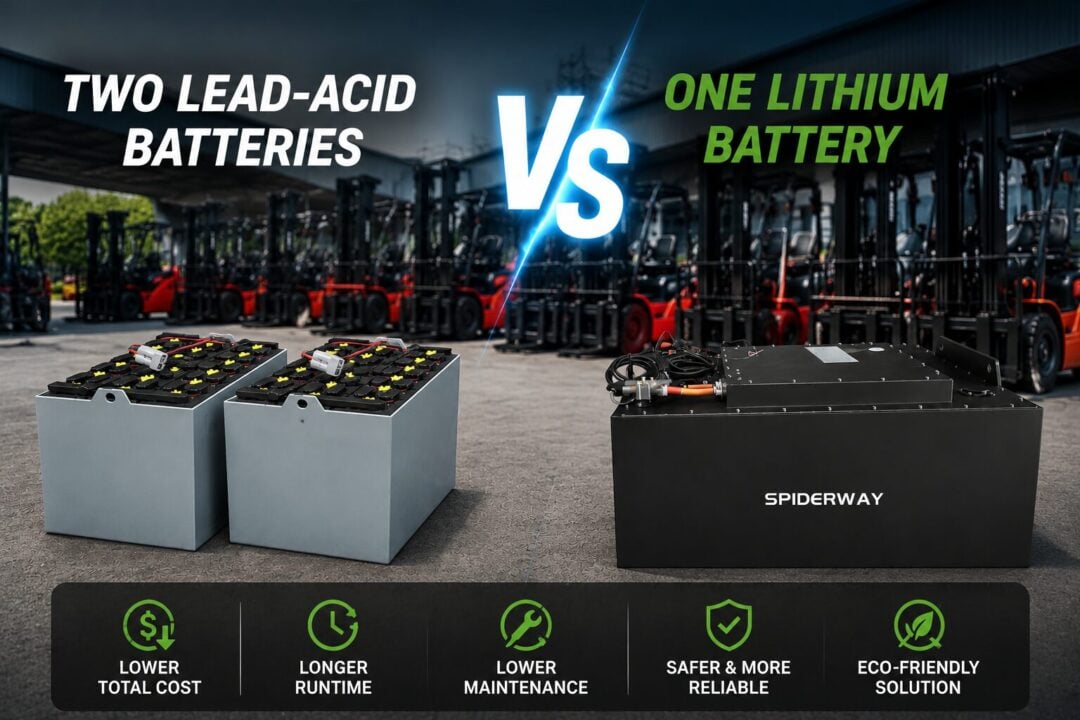
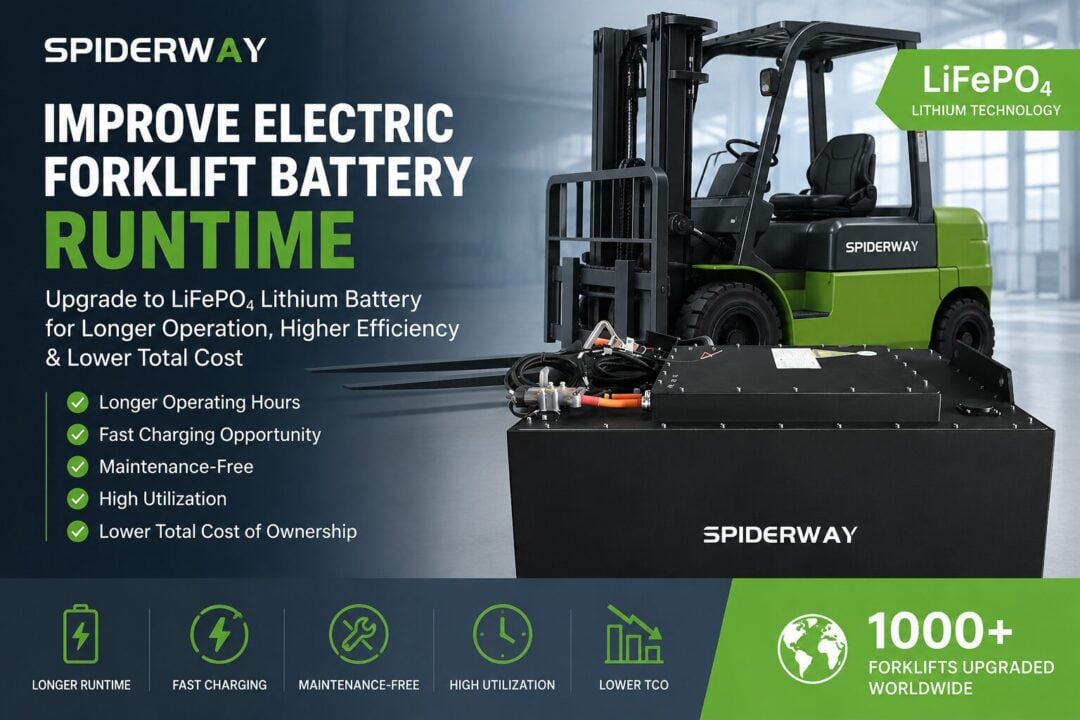
For many warehouse and distribution operations, the economic case for switching to lithium iron phosphate (LiFePO4) forklift batteries rests on a simple idea: replacing two lead-acid batteries per truck with a single lithium unit. But that simplicity often masks a more complex reality. A second lead-acid battery usually exists not because it holds extra energy but because the first must charge, cool, or wait between shifts. Therefore, the comparison should focus on operational scheduling, not just energy storage.
This article explains why one lithium battery can potentially replace two lead-acid batteries, how to validate such a switch with energy-balance and total-cost-of-ownership analyses, and where the strategy may or may not be a sound investment.
The Real Meaning of Two Lead-Acid Batteries per Forklift
In a conventional flooded lead-acid setup for a two-shift operation, each forklift typically has one battery installed while another charges, cools, and waits. This model demands dedicated chargers, a battery-changing area with stands or lanes, lifting equipment, and labor for watering, cleaning, and swapping batteries. The ‘two batteries per truck’ is thus a product of conventional charging cycles.

However, not every lead-acid fleet operates this way. In light, single-shift duty, one conventionally charged battery may suffice, and advanced lead-acid systems can support opportunity charging. The key is to benchmark the comparison against the customer’s actual lead-acid operation, not a one-size-fits-all assumption.
Fleet-Level Comparison at a Glance
| Decision factor | Two lead-acid batteries per forklift | One lithium battery per forklift |
|---|---|---|
| Battery population | Commonly two operating assets per truck in multi-shift conventional charging | Potentially one operating battery per truck |
| Battery changes | Normally required between operating cycles | Usually eliminated when opportunity charging is sufficient |
| Charging method | Often off-truck conventional charging | Usually in-truck opportunity charging |
| Recovery time | Charging and thermal recovery must be scheduled | Short charging sessions can be distributed across the working day |
| Battery-handling equipment | May require hoists, rollers or extraction systems | Normally unnecessary for routine charging |
| Routine maintenance | Watering, cleaning, equalization and electrolyte-related inspections | No watering, but electrical, cooling, connector and diagnostic inspections remain necessary |
| Charging location | Frequently centralized | Can be distributed near break areas, staging points or parking locations |
| Operating model | Battery rotation | Energy replenishment |
| Fleet resilience | Spare batteries provide built-in operational redundancy | Redundancy must be designed separately |
| Upfront battery cost | Usually lower per battery | Usually higher per battery |
| Total installed cost | Includes additional batteries and handling infrastructure | Includes lithium chargers, integration and possible electrical upgrades |
| Best fit | Light use, low capital budgets or sites with existing battery infrastructure | Multi-shift fleets with predictable charging windows and high battery-handling costs |
Why One Lithium Battery Can Remain in the Forklift
The operational advantage of lithium lies in how energy is restored. Instead of treating the battery as a removable asset, a lithium forklift treats it as part of the truck. Operators connect the forklift to a compatible charger during breaks, shift changes, loading delays, and other idle periods. This approach adds energy before deep discharge occurs, maintaining the state of charge within a controlled band throughout the day. For this to work, the energy recovered during those charging windows must at least match the energy consumed during the duty cycle, with a safe reserve.
The Energy-Balance Test
Battery selection starts with energy demand, not battery count. For each forklift, you need to know:
- How much usable energy does each forklift consume daily?
- How much usable energy is available from the proposed lithium battery?
- How much energy can be recovered during realistic charging windows?
A simplified daily energy balance is:
End-of-day usable energy = Starting usable energy + Energy recovered through opportunity charging − Energy consumed by the forklift

The one-battery strategy is sustainable only when end-of-day usable energy remains at or above a required minimum reserve. This reserve should account for unexpected workload, missed charging, battery ageing, temperature derating, charger downtime, operator behaviour, and the energy to return to a charging point.
Energy recovered per charging session can be estimated as:
Energy recovered (kWh) = Average DC charging power (kW) × Actual connected time (hours) × Effective charging factor

Here, average DC charging power is not the charger’s nameplate but the actual delivered power. The effective factor covers BMS limits, temperature derating, interruptions, and operator compliance. For robust planning, use data from charger energy records, battery telemetry, fleet management systems, or temporary DC metering, not just rated ampere-hours.
A Worked Fleet Example
Consider a hypothetical fleet of 20 electric forklifts working two shifts. Monitoring shows each forklift consumes 18 kWh per shift, totaling 36 kWh daily. The proposed lithium battery offers 21 kWh of usable energy. Reliable charging windows are 30 minutes during each shift and at shift change, totaling 1.5 hours. If the charger provides 15 kW average DC output with a 90% effective factor, energy recovered is:
Energy recovered = 15 kW × 1.5 h × 0.90 = 20.25 kWh

The daily balance is then:
End-of-day usable energy = 21 + 20.25 − 36 = 5.25 kWh

On paper, the system finishes with 5.25 kWh, so the one-battery strategy may be feasible, subject to checks. However, if production delays cut connected time to 45 minutes, energy recovered drops to 10.125 kWh, leaving a shortfall of 4.875 kWh. The same battery and charger succeed in one facility but fail in another if the site cannot reliably replenish energy at the right times.
Peak Power Can Defeat an Energy-Only Calculation
Even with sufficient energy, the battery must meet the forklift’s peak power demands during simultaneous travel and lifting, ramp climbing, heavy loads, and other high-current events. The permitted battery output at the relevant temperature and state of charge must be equal to or greater than the forklift’s peak demand. BMS current limits, temperature extremes, low SOC, connector heating, and communication faults can curtail power. Therefore, the engineering review should verify continuous and peak currents, temperature derating, regenerative current, and low-SOC power limits.
Total Cost of Ownership: More Than Battery Prices
A fair financial model compares five-year TCO, not just battery prices. For lead-acid, include the full battery fleet with rotation batteries, chargers, handling equipment, battery room costs, electricity, maintenance, labor, replacements, and residual value. For lithium, include batteries, compatible chargers, electrical upgrades, installation, electricity, inspections, replacements, and residual value. Use identical assumptions for analysis period, fleet size, schedule, labor and electricity rates, production forecast, discounting, and residual values. Avoid zero-replacement assumptions for lithium unless warranty and operating evidence support it.

Cost Categories
Battery Assets
Count all batteries, including those installed, in rotation, spares, and replacements. For lithium, include central spares, diagnostic equipment, and transport.
Chargers and Electrical Infrastructure
Lithium usually requires new chargers with CAN communication, additional ports, load management, and possibly transformer or panel upgrades. Verify that chargers meet output voltage, current, profile, and BMS communication requirements; voltage compatibility alone is insufficient.

Battery-Change Labor
Calculate annual labor cost as:
Number of forklifts × Changes per truck per day × Operating days per year × Minutes per change ÷ 60 × Fully burdened labor rate
Example: 20 trucks, 1 change per day, 250 days, 10 minutes, $30/hour yields $25,000/year. Add costs for lost availability and queueing only when data supports.
Maintenance
Lead-acid maintenance includes watering, equalization, cleaning, and spill response. Lithium reduces routine maintenance but still requires connector, cable, mounting, cooling, charger, BMS, and firmware checks. The comparison is lower routine maintenance, not zero.
Electricity Cost
Measure AC kWh from the grid and multiply by the blended rate, including demand charges. Compare actual wall-plug energy, not just battery capacity or charger efficiency.
Battery Room and Redundancy
Count savings from releasing battery room only if the space gains an alternative use. Design resilience with spare batteries, chargers, and documented service procedures, as removing the second battery reduces inherent redundancy.
Operational Value of Eliminating Battery Changes
Eliminating swaps can boost truck availability, operator productivity, safety, and space utilization. However, value varies: a change during a peak shipping window is more valuable than one during wait time. Separate direct cash savings, recoverable labor, potential capacity, risk reduction, and reusable space in the financial model.
Charging Infrastructure Becomes the Critical System
Once batteries no longer rotate, dependable charging access determines fleet uptime. Ask: How many forklifts charge simultaneously? Where are chargers placed? Can operators reach them? What is the coincident electrical load? For example, eight 18-kW chargers create a 144-kW load. Design for input voltage, phase, power factor, peak demand charges, cables, breakers, and local codes. Apply diversity only if scheduling prevents simultaneous full power draws. Position chargers at actual stopping points, not just convenient outlets.
Pilot Before Scaling
A full conversion should not start with a bulk purchase. Run a controlled pilot:
Phase 1: Baseline
Record operating hours, grid energy, battery changes, downtime, maintenance, water use, charger faults, utilization, and work completed.
Phase 2: Select representative trucks
Include normal, high-utilization, demanding hydraulic, and cold-storage units, if applicable.

Phase 3: Monitor the pilot
Track SOC, energy consumed and recovered, peak currents, temperatures, charger availability, operator compliance, and faults. Use real data to validate the model before scaling.
When Lead-Acid May Still Be the Rational Choice
Lithium is not always lowest cost. Lead-acid may be preferable when the forklift runs only a few hours a day, existing infrastructure is fully depreciated, labor costs are low, no dependable charging windows exist, electrical upgrades are costly, or the application requires special certifications not available with lithium. A technically possible conversion is not always financially sensible.
Conclusion: A Data-Driven Decision
One lithium battery can replace two lead-acid batteries per forklift, but only when the energy balance, peak power, charging infrastructure, and total cost all work. Lithium offers real advantages in multi-shift operations with predictable breaks and high labor costs. But the economics hinge on site-specific factors: energy demand, recovery windows, and infrastructure readiness. For operations weighing the switch, a pilot and measured analysis provide far better evidence than generic claims.
Supplier & Author Profile

- SpiderwayVerified
SPIDERWAY is a trusted LiFePO4 battery manufacturer specializing in golf cart, marine, RV, solar energy storage, industrial, and custom lithium battery solutions. We deliver OEM/ODM services, factory-direct quality, global shipping, and expert support for distributors, brands, and wholesale buyers worldwide.
Latest entries
- 2026-09-17Liquid-Cooled LiFePO4 Battery Packs for Heavy-Duty Electric Machinery
- 2026-09-16598.92V 180.87kWh High-Voltage Lithium Battery System for Heavy-Duty Electric Machinery
- 2026-09-08Exploring SPIDERWAY’s LiFePO4 Battery Plant in Hefei: A Look Inside an Advanced Industrial Lithium Battery Production Line
- 2026-09-08Evolution of LiFePO4 Battery Energy Density: A Decade of Advances and Future Outlook (2015–2035)