
Inside a Lithium Battery Factory: What Overseas Buyers Never See
Most overseas buyers never visit the factory that builds their lithium batteries. They compare quotations, request datasheets, review certifications, and perhaps watch a few polished factory videos. But what actually happens between a pallet of lithium cells arriving at a factory and a finished battery leaving for Europe, North America, Australia, or the Middle East remains largely invisible.
As a product manager at SPIDERWAY, I spend far more time inside production workshops than in meeting rooms. Conversations with overseas distributors, forklift OEMs, rental fleets, and warehouse operators have taught me one thing: buyers don’t simply want to know what a battery can do. They increasingly want to understand how it was built.
This article is not a factory advertisement. Instead, it is a practical walkthrough of how an industrial LiFePO4 battery pack moves through production—from incoming cells to final shipment—and why every manufacturing decision directly influences safety, consistency, and long-term reliability.
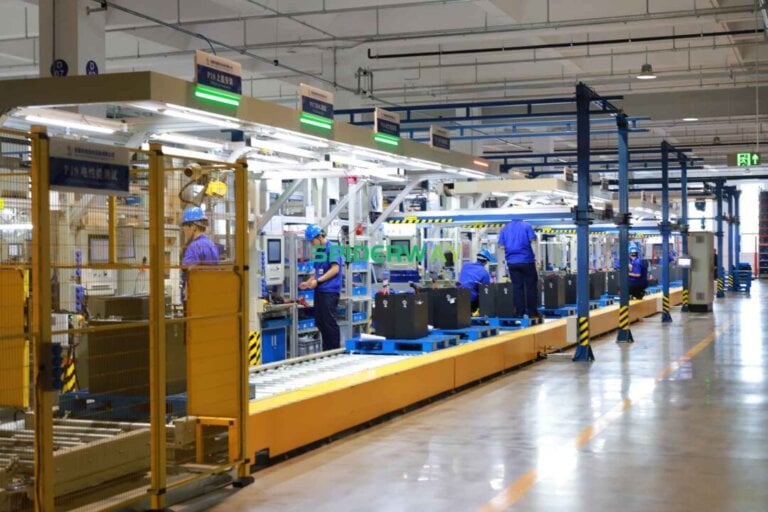
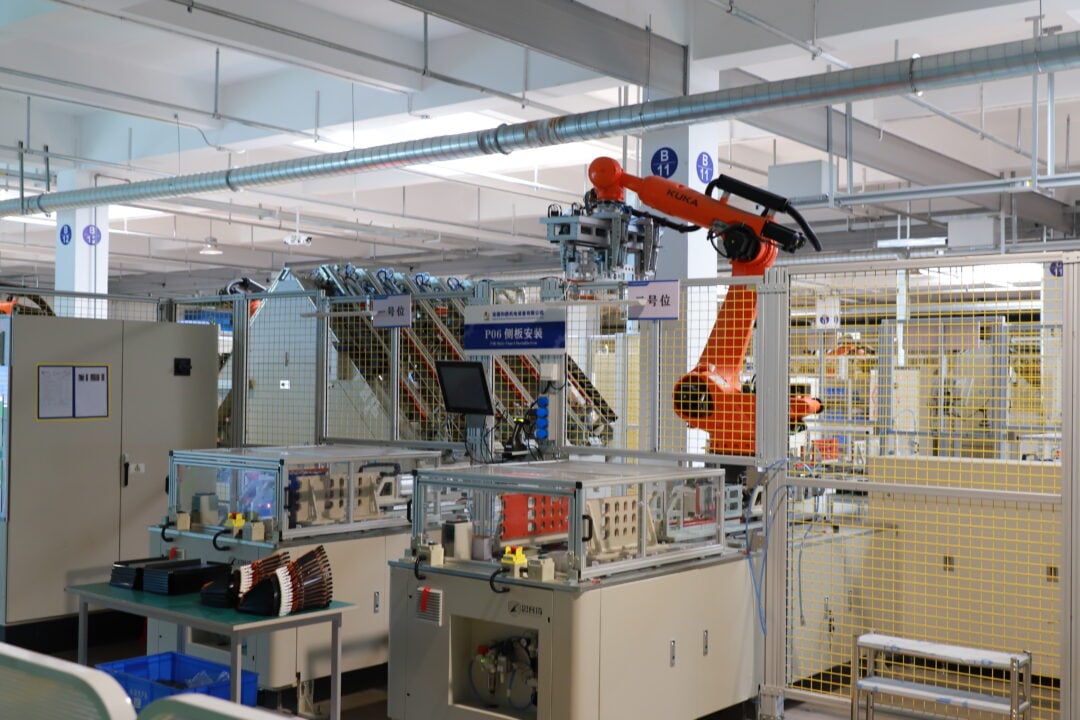
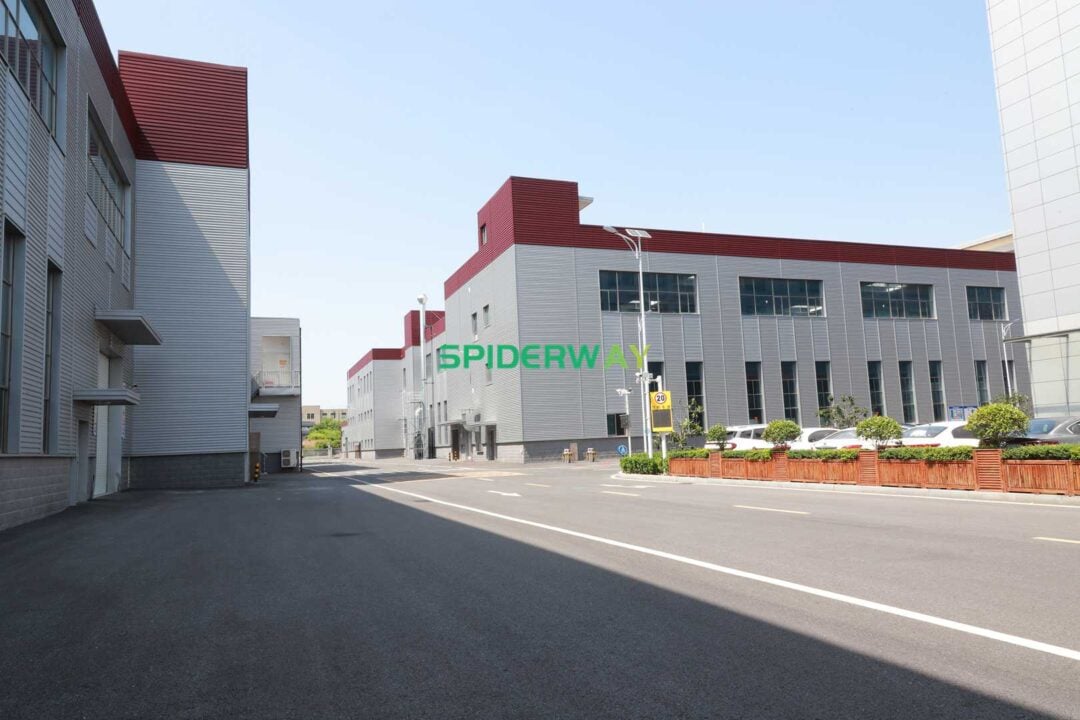
The exact sequence varies slightly depending on battery configuration, but the engineering logic remains remarkably consistent across industrial battery manufacturing. SPIDERWAY’s production combines automated manufacturing with multiple quality inspection stages throughout the process.
Before Production Starts: Engineering Begins Long Before Assembly
Many buyers imagine battery manufacturing starts when workers begin welding cells together. In reality, production usually starts days or weeks earlier. Before any hardware enters production, engineers finalize:
- Battery voltage and capacity
- Cell configuration
- Mechanical enclosure
- Current path design
- Fuse selection
- BMS configuration
- Communication protocol
- Thermal management strategy
- Vehicle compatibility
- Production documentation
A forklift battery designed for a three-shift warehouse follows very different engineering priorities from one intended for occasional warehouse use. The battery pack is not simply a container of cells. It is an engineered electrical system.
Step 1 — Incoming Cell Inspection
The first quality checkpoint happens before manufacturing begins. Even premium Grade-A cells are never assumed to be identical. Each batch is inspected for parameters including:
- Open circuit voltage
- Internal resistance
- Capacity consistency
- Physical appearance
- Manufacturing date
- Traceability codes
Cells outside predefined tolerances are isolated. This prevents small inconsistencies from becoming large problems after thousands of charge cycles. A battery pack is only as consistent as its least consistent cell.
Step 2 — Cell Matching
This is one of the least visible—but most important—steps. Cells with similar electrical characteristics are grouped together before assembly. Typical matching parameters include:

- Voltage
- Internal resistance
- Capacity
Why does this matter? Imagine one runner in a relay race being significantly slower than everyone else. The entire team becomes limited by that runner. The same principle applies inside lithium battery packs. Proper matching reduces imbalance over time, allowing the Battery Management System (BMS) to spend less energy correcting cell differences.
Step 3 — Module & PACK Assembly
Only after cell matching does physical assembly begin. Depending on battery design, technicians or automated equipment assemble:
- Cell holders
- Compression structures
- Busbars
- Insulation materials
- Mechanical supports
- High-current connectors
Industrial forklift batteries experience continuous vibration, heavy impacts, and frequent charging. Mechanical rigidity is therefore just as important as electrical performance. Loose structures eventually become electrical problems.
Step 4 — Busbar Welding
For most buyers, welding appears straightforward. For engineers, it is one of the highest-risk production stages. Laser welding or precision resistance welding connects hundreds of electrical joints. Every weld must achieve:

- Low electrical resistance
- High mechanical strength
- Minimal heat influence
- Consistent penetration
Poor weld quality may not fail immediately. Instead, increased resistance generates additional heat after hundreds or thousands of operating hours. That hidden resistance eventually becomes lost efficiency—or, in severe cases, failure.
Step 5 — BMS Installation
The Battery Management System is often described as the battery’s brain. That description is only partially accurate. A modern industrial BMS simultaneously performs multiple tasks:
- Cell voltage monitoring
- Current measurement
- Temperature monitoring
- Cell balancing
- Overcharge protection
- Over-discharge protection
- Short-circuit protection
- CAN communication
- Vehicle communication
- Fault recording
For industrial vehicles, software compatibility is often just as important as hardware quality. A battery with an excellent cell pack but poor communication integration may still create operational issues. Industrial BMS platforms increasingly support intelligent monitoring and communication protocols for industrial equipment.
Step 6 — Wiring and High-Voltage Verification
Before closing the enclosure, technicians inspect every electrical connection. This stage includes verification of:
- Cable routing
- Connector locking
- Polarity
- Fuse installation
- High-voltage insulation
- Ground isolation
Small wiring mistakes discovered now are inexpensive. The same mistakes discovered after shipment become costly warranty cases.
Step 7 — Initial Functional Testing
At this stage, the battery still hasn’t reached the customer. But electrically, it is already alive. Engineers verify:
- BMS startup
- Communication
- Voltage readings
- Sensor accuracy
- Current detection
- Safety logic
Only after passing these checks does the battery proceed to charging.
Step 8 — Formation and Aging
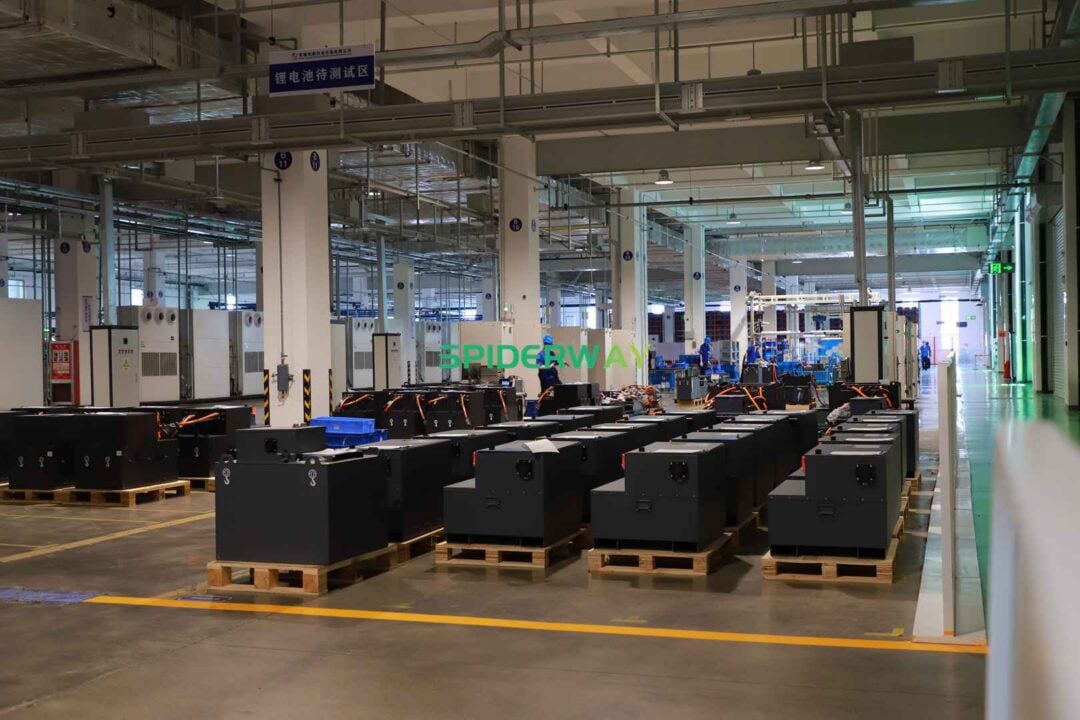
Many buyers underestimate this stage. In reality, it is one of the longest production processes. Every completed battery undergoes controlled charging and discharging. The objectives include:
- Stabilizing cell chemistry
- Verifying pack consistency
- Confirming capacity
- Detecting early failures
- Recording performance data
Early-life defects usually appear here—not after the battery reaches the customer. This stage intentionally exposes problems inside the factory rather than in the field. Formation and aging are widely recognized as critical quality-control stages in lithium battery manufacturing, and SPIDERWAY’s automated production line includes dedicated formation and aging processes.
Step 9 — Comprehensive Performance Testing
Now the battery must prove it performs exactly as designed. Testing may include:
Electrical Tests
- Capacity
- Voltage accuracy
- Charge efficiency
- Discharge efficiency
Safety Tests
- Protection response
- Over-current simulation
- Short-circuit response
- Temperature monitoring
Communication Tests
- CAN Bus
- RS485
- Vehicle protocol compatibility
Mechanical Inspection
- Fasteners
- Enclosure
- Waterproof sealing
- Labels
- Connectors
Each battery receives its own inspection record. Traceability matters because industrial batteries are expected to remain in service for many years.
Step 10 — Cleaning and Final Appearance Inspection
Industrial buyers notice details. Before packaging, every battery undergoes visual inspection for:

- Surface cleanliness
- Label accuracy
- Connector protection
- Paint finish
- Mechanical damage
A clean battery does not necessarily perform better. But careful finishing often reflects disciplined manufacturing.
Step 11 — Packaging for International Transport
Shipping an industrial battery is an engineering task—not simply a logistics task. Packaging must consider:
- Shock protection
- Moisture resistance
- Forklift handling
- Sea freight vibration
- Container stacking
- International transport regulations
Industrial batteries frequently travel thousands of kilometers before reaching the customer. Packaging becomes part of product quality.
Step 12 — Shipment and Traceability
The final stage is often invisible to buyers. Each battery leaves the factory with traceable production information linked to:

- Cell batch
- BMS version
- Assembly records
- Test data
- Production date
- Serial number
When service is required years later, engineers can often trace the battery back to its manufacturing history. That historical data shortens diagnosis and improves after-sales support.
What Overseas Buyers Usually Never Notice
When buyers compare suppliers, they often compare price, voltage, capacity, and warranty. Engineers often compare something entirely different: cell consistency, weld quality, mechanical compression, thermal management, BMS calibration, inspection discipline, process repeatability, and traceability. Many battery failures do not originate from poor battery chemistry. They originate from small manufacturing details that were overlooked during production.
What We Have Learned at SPIDERWAY
Working inside an industrial battery factory changes your perspective. You stop thinking of batteries as products. You begin thinking of them as manufacturing systems where hundreds of small engineering decisions accumulate into long-term reliability. At SPIDERWAY, our production philosophy has never been to chase the highest output at any cost. Instead, we focus on building repeatable manufacturing processes that combine Grade-A cells, automated assembly, intelligent BMS integration, multi-stage testing, and full production traceability for industrial LiFePO4 battery packs. Our manufacturing facilities employ automated production equipment and quality-control systems designed to improve consistency across industrial battery production.
For overseas buyers, understanding how a battery is manufactured provides a different way to evaluate suppliers. Beyond specifications and certifications, the production process reveals how quality is created, controlled, and verified long before the battery reaches a forklift, aerial work platform, airport GSE vehicle, or warehouse floor. In industrial energy systems, reliability is rarely the result of one breakthrough component. It is the outcome of thousands of manufacturing details executed correctly—every single day.
Supplier & Author Profile

- SpiderwayVerified
SPIDERWAY is a trusted LiFePO4 battery manufacturer specializing in golf cart, marine, RV, solar energy storage, industrial, and custom lithium battery solutions. We deliver OEM/ODM services, factory-direct quality, global shipping, and expert support for distributors, brands, and wholesale buyers worldwide.
Latest entries
- 2026-09-17Liquid-Cooled LiFePO4 Battery Packs for Heavy-Duty Electric Machinery
- 2026-09-16598.92V 180.87kWh High-Voltage Lithium Battery System for Heavy-Duty Electric Machinery
- 2026-09-08Exploring SPIDERWAY’s LiFePO4 Battery Plant in Hefei: A Look Inside an Advanced Industrial Lithium Battery Production Line
- 2026-09-08Evolution of LiFePO4 Battery Energy Density: A Decade of Advances and Future Outlook (2015–2035)