How to Prevent Dormancy in a LiFePO4 Battery During Storage
What Battery Dormancy Really Means
As a product engineer at SPIDERWAY, I often receive questions about lithium iron phosphate batteries that have been stored for several months and no longer appear to work. Users may press the power button, connect a charger, or check the display and see no response. This condition is commonly described as a battery entering sleep mode or dormancy. In most cases, the battery has not permanently lost all of its energy. Instead, the battery management system, or BMS, has disconnected the battery from its external terminals to protect the cells.
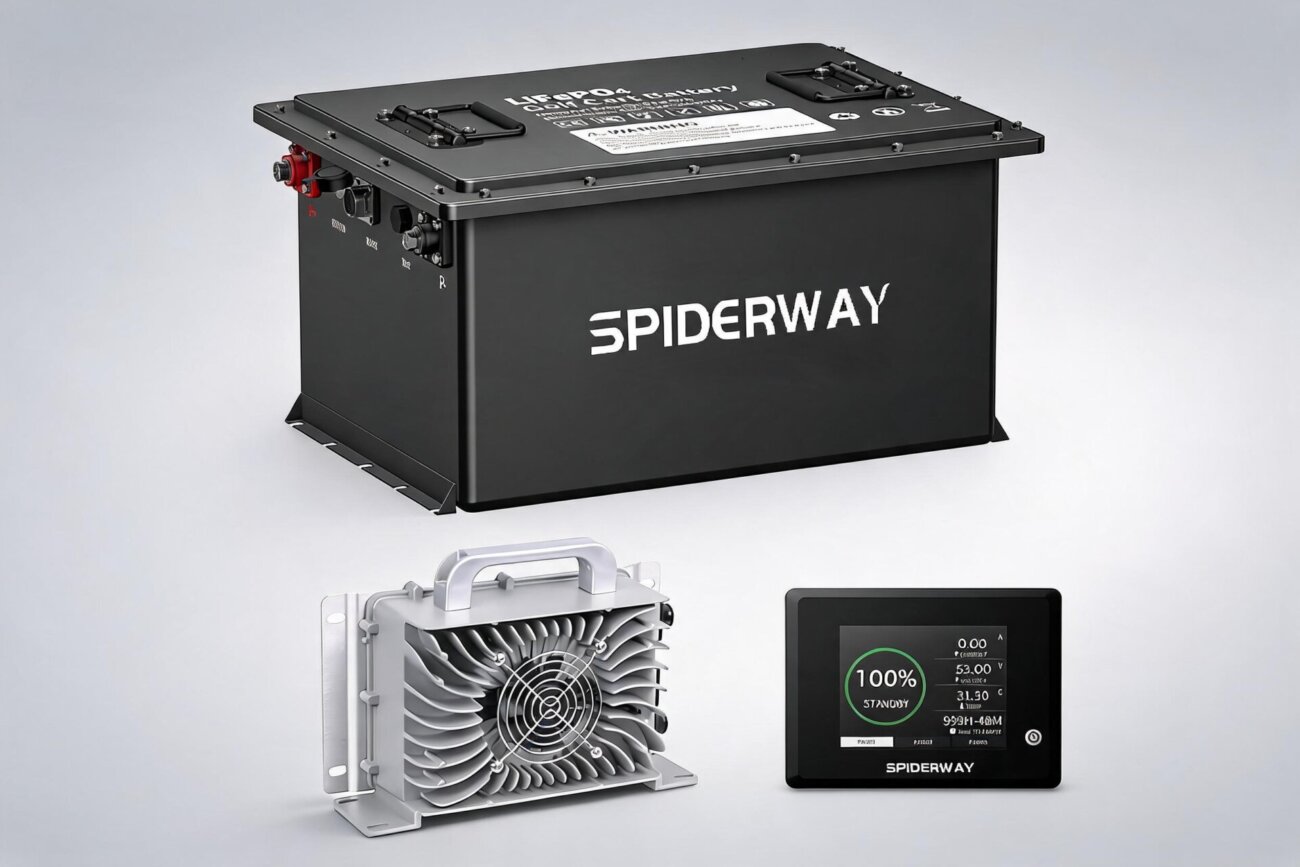
A LiFePO4 battery contains several main parts: individual lithium iron phosphate cells, a BMS, power terminals, temperature sensors, wiring, and sometimes a display, communication module, or internal heating system. The BMS continuously monitors cell voltage, pack voltage, current, and temperature. If the battery remains unused for a long time, its voltage can gradually decline because of the battery’s small self-discharge, the BMS’s standby consumption, or connected equipment that continues drawing a small current. When the voltage falls below a programmed protection threshold, the BMS may open its discharge circuit. If the voltage declines further, it may also disable charging input.
This protective condition is different from ordinary battery aging. Dormancy is a temporary operating state created by protection electronics. Aging is a gradual, generally irreversible reduction in capacity and power capability. A battery in dormancy may recover after an appropriate charging procedure, while a severely over-discharged or physically damaged battery may require professional inspection or replacement.
The exact behavior varies by product. Some BMS designs enter low-power sleep after a period without current. Others wake automatically when a compatible charger is connected. Certain batteries require a load, a charger activation signal, a communication command, or a manual wake-up switch. Therefore, the user manual and the manufacturer’s charging requirements should always take priority over general advice.
Typical Signs and Possible Effects
A dormant LiFePO4 battery can show several recognizable symptoms. The battery may power a device briefly and then shut down, or it may provide no output at all. A charger may show standby, no-battery, or error status because the BMS has isolated the cells from the charger. A voltage reading at the external terminals may be unusually low or may read zero, even though the cells still contain some energy. On batteries with a display, the screen may remain off. Bluetooth or other communication functions may also disappear because the BMS has reduced its own power consumption.
These symptoms do not automatically prove that the battery is dormant. A disconnected cable, blown fuse, faulty charger, damaged connector, failed switch, or incorrect charger can create similar results. A professional diagnosis should consider the complete system rather than assuming that the battery itself is at fault.
Short-term dormancy is usually a protective response and may have little lasting effect if the battery is reactivated promptly. However, a battery that remains deeply discharged for a long period can suffer permanent capacity loss. Low cell voltage may increase internal chemical stress and create imbalance between cells. If one cell falls much lower than the others, the BMS may prevent normal charging even when the pack’s average voltage appears acceptable. Repeatedly allowing a battery to reach protection shutdown can also reduce its practical service life.
Storage conditions affect the outcome. High temperatures accelerate chemical aging and self-discharge, while freezing temperatures can make charging unsafe. Humidity can corrode terminals and connectors. Mechanical impact, water intrusion, or swelling are warning signs of physical damage rather than normal dormancy. Do not attempt to reactivate a battery that is swollen, cracked, leaking, unusually hot, has a strong chemical odor, or shows signs of burning. Isolate it in a safe location and contact the supplier or a qualified battery technician.
Why Long-Term Storage Can Trigger Sleep Mode
Several mechanisms can cause a LiFePO4 battery to enter a protective sleep state during long-term inactivity. The first is normal self-discharge. LiFePO4 cells generally have a low self-discharge rate compared with many older battery chemistries, but low does not mean zero. Over a long period, stored energy gradually decreases. The BMS and its monitoring circuits also consume a small amount of power. In a properly designed battery, this standby consumption is very low, yet months of storage can still matter, particularly when the battery starts storage at a low state of charge.
The second mechanism is a hidden external load. In vehicles, boats, floor machines, solar systems, and backup power installations, connected equipment may continue drawing current when it appears to be switched off. Displays, alarms, inverters, tracking devices, control boards, and communication modules can all consume energy. A small continuous load may discharge a battery more deeply than expected. Disconnecting only the main appliance may not be enough if another circuit remains connected.
The third factor is cell imbalance. A battery pack is made of multiple cells connected in series. The BMS protects the weakest cell, not simply the average pack voltage. If one cell has slightly less capacity or a higher self-discharge rate, it may reach the low-voltage threshold before the other cells. The BMS then shuts down the pack to prevent that cell from being over-discharged. This is why two batteries with the same nominal voltage can behave differently after storage.
Temperature also influences storage behavior. Higher temperatures increase self-discharge and accelerate calendar aging. Very low temperatures reduce chemical activity and can cause a BMS to block charging until the cells warm to an acceptable range. Charging a frozen lithium battery is unsafe because lithium plating can occur inside the cells. Long-term storage in a hot vehicle, direct sunlight, damp shed, or unheated outdoor enclosure is therefore unsuitable. Good storage begins with a moderate temperature, a suitable state of charge, and complete disconnection from unnecessary loads.
How to Check a Battery Before Reactivation
Before trying to wake a dormant battery, inspect the situation systematically. First, remove the battery from equipment if practical, or switch off and isolate every external load. Check that the positive and negative cables are connected to the correct terminals and that no terminal is loose, corroded, or damaged. Inspect the fuse, circuit breaker, main switch, and connector. A battery that appears asleep may simply be separated from the system by an open fuse.
Next, confirm the charger type. A LiFePO4 battery should be charged with a charger designed for its nominal voltage and chemistry. For example, a 12.8-volt LiFePO4 battery normally requires a charging profile appropriate for a four-cell series pack, while a 25.6-volt battery requires a different voltage range. The charger must not be selected only by matching a label such as 12 volts or 24 volts. Verify its output voltage, current rating, connector polarity, and charging method. Lead-acid chargers with equalization or desulfation modes can be unsuitable and may damage a lithium battery or cause the BMS to disconnect again.
Measure the temperature of the battery housing and, where possible, the storage environment. Do not charge a battery that is frozen, extremely hot, wet, visibly damaged, or giving off an abnormal odor. If a multimeter is available, measure the terminal voltage using the correct range and polarity. A zero reading does not necessarily mean that the cells are empty because a sleeping BMS may isolate the terminals. Conversely, a normal-looking terminal voltage does not prove that every cell is healthy.
Record the battery model, nominal voltage, capacity, storage duration, last known state of charge, and any fault indication. This information helps the supplier identify whether the BMS has entered low-voltage protection, over-temperature protection, communication lockout, or another state. If the battery was stored for a very long time, has been deeply discharged, or is used in a high-value installation, professional testing is the prudent choice. Never bypass the BMS, short the terminals, open the battery enclosure, or connect an unregulated power source to force a wake-up.
Safe Ways to Reactivate a Dormant LiFePO4 Battery
The safest reactivation method is to use the procedure specified by the battery manufacturer. For many SPIDERWAY batteries, the first step is to remove all loads and connect a compatible LiFePO4 charger with the correct polarity. Some BMS units wake when they detect charging voltage. Allow the charger to remain connected for a short observation period and check whether its status changes from standby to charging. Do not leave an unknown or damaged battery unattended during this process.
If the battery has a dedicated power or wake button, use it according to the manual. Some models require the button to be pressed briefly, while others use a longer press. A few products have a low-power sleep switch that must be turned on before charging. For batteries installed in vehicles or machines, turning the main switch off and on after connecting the charger may restore communication, but this should be done only when the wiring and equipment are known to be correct.
Once charging begins, observe the battery for abnormal heat, smell, noise, swelling, or repeated charger faults. The initial charging current may be low because the BMS is balancing cells or limiting recovery from a low state of charge. This can be normal, but the battery should not remain in an error state indefinitely. If the charger immediately stops, the terminal voltage remains unchanged, or the BMS reports a low-cell fault, disconnect the charger and contact SPIDERWAY or another qualified service provider.
Do not try to recover the battery by applying a higher voltage, connecting another battery in parallel, using a lead-acid boost charger, or bypassing the protection circuit. These actions can create excessive current, overcharge an individual cell, damage the BMS, or cause a fire. A service technician can use controlled equipment to assess cell voltage, internal resistance, balance, and insulation. If a cell is below the manufacturer’s recovery limit, safe replacement may be more appropriate than forced charging. Reactivation is successful only when the battery can complete a normal charge, maintain stable voltage under load, and operate without recurring protection faults.
Recommended Storage Procedure for Long Periods
Preventing dormancy is easier than recovering from it. Before storing a LiFePO4 battery, charge it to the storage level recommended by the manufacturer. A moderate state of charge is normally preferable to storing at either 100 percent or near empty for many months. In general, a range around 40 to 60 percent is commonly suitable for long-term storage, but the exact recommendation depends on the cell design, BMS, product model, and expected storage duration. For short periods, a fully charged battery may be acceptable, especially when the product is needed for immediate use, but it should not be kept continuously full in a hot environment.
Disconnect all external loads, including inverters, chargers, vehicle electronics, displays, and auxiliary accessories. If the product has a manufacturer’s storage switch, use it. Do not remove internal wiring or disconnect the BMS unless a trained technician instructs you. Place the battery in a dry, clean, ventilated area away from direct sunlight, heat sources, sparks, and flammable materials. Avoid storing it inside a sealed container where heat or moisture can accumulate. Keep terminals protected from accidental contact and ensure that the battery cannot fall or be crushed.
Storage temperature should remain within the range stated in the product documentation. A moderate, stable environment is better than repeated cycles of hot and cold. Avoid leaving a battery in a car during summer or in a location where it can freeze. If the battery has a built-in heater, confirm whether the heater has its own standby consumption and whether the product should remain connected to a charger during cold-weather storage.
Label the storage date and last inspection date. For longer storage, inspect the battery periodically and measure voltage only when the procedure is safe and meaningful. A scheduled check every few months is often useful, but the interval should be shortened for older batteries, batteries stored in warm conditions, or systems with unavoidable standby loads. If the state of charge has fallen significantly, recharge it with the correct charger before the BMS reaches low-voltage protection.
Maintenance Habits That Reduce Dormancy Risk
A small maintenance routine can prevent most storage-related problems. Establish a battery log containing the model, installation date, charge dates, storage conditions, and any fault codes. This makes gradual changes easier to identify. Before a battery is placed into storage, record its state of charge and confirm that all connected equipment has been disconnected. After storage, perform a controlled recharge and a basic load test rather than immediately returning the battery to a critical application.
For equipment that is used only occasionally, recharge the battery according to the manufacturer’s recommended interval. The purpose is not to keep it continuously cycling. The purpose is to prevent the pack from remaining at an excessively low state of charge for months. During periodic checks, look for corrosion, damaged insulation, loose connectors, moisture, swelling, and unusual odor. Check the surrounding equipment as well, because a hidden parasitic load can discharge a healthy battery.
Use the correct charger every time. The charger should match the battery’s nominal voltage and LiFePO4 chemistry, and its current should remain within the battery’s specification. Avoid charging immediately after moving a battery from freezing conditions; allow it to reach a safe temperature first. Similarly, do not charge a hot battery just because the charger is available. Thermal protection is valuable, but good operating practice reduces the number of protection events.
During regular use, avoid deliberately draining the battery until the BMS disconnects it. Low-voltage cutoff is an emergency protection function, not a recommended daily operating target. If the battery repeatedly shuts down under normal loads, investigate the load size, cable voltage drop, connector condition, cell balance, and BMS fault history. Excessive current or an undersized cable can create a voltage drop that makes the battery appear empty even when usable energy remains.
Battery monitoring can also help. A reliable display, shunt, or approved communication system gives better information than estimating charge from terminal voltage alone. LiFePO4 voltage remains relatively flat across much of its discharge range, so voltage-only estimates can be misleading. State-of-charge data should be calibrated and interpreted together with current, temperature, and operating history.
Common Misunderstandings and Final Guidance
One common misunderstanding is that every unresponsive battery is permanently dead. A sleeping BMS can make a battery appear completely inactive, but the cause must be confirmed before recovery is attempted. The opposite misunderstanding is equally risky: assuming that every dormant battery can be revived. If cells have been deeply over-discharged, physically damaged, exposed to water, or left hot for a long period, recovery may be unsafe or economically unjustified.
Another misconception is that keeping a battery connected to a charger all the time prevents dormancy. Continuous charging may keep the battery ready, but it can also keep the cells at a high state of charge and expose the system to charger, wiring, or environmental risks. Whether continuous connection is appropriate depends on the charger, BMS, application, temperature, and manufacturer’s design. A maintenance charger should never be substituted casually for a properly specified LiFePO4 charging system.
Users also sometimes believe that a higher charging voltage will force the BMS to wake. This is not a safe solution. Protection thresholds are designed around cell voltage, current, temperature, and timing. Raising the voltage can create a dangerous condition without correcting the reason for the shutdown. Similarly, connecting a second battery to boost a dormant pack can cause uncontrolled current if the batteries differ in voltage or condition.
The practical rule is straightforward: store the battery at an appropriate moderate state of charge, disconnect every unnecessary load, protect it from heat and freezing temperatures, inspect it periodically, and use only an approved charger. If the battery enters dormancy, isolate it, inspect it, verify the charging equipment, and follow the product-specific wake-up procedure. Stop immediately when there is heat, swelling, odor, damage, or a recurring fault.
At SPIDERWAY, our product engineers consider storage behavior, BMS protection, charging compatibility, and service conditions together when evaluating LiFePO4 battery systems. A well-designed battery can remain reliable during periods of inactivity, but correct storage and timely maintenance remain essential. When the battery’s history or condition is uncertain, professional testing is the safest and most accurate next step.
Supplier & Author Profile

- SpiderwayVerified
SPIDERWAY is a trusted LiFePO4 battery manufacturer specializing in golf cart, marine, RV, solar energy storage, industrial, and custom lithium battery solutions. We deliver OEM/ODM services, factory-direct quality, global shipping, and expert support for distributors, brands, and wholesale buyers worldwide.
Latest entries
- 2026-09-17Liquid-Cooled LiFePO4 Battery Packs for Heavy-Duty Electric Machinery
- 2026-09-16598.92V 180.87kWh High-Voltage Lithium Battery System for Heavy-Duty Electric Machinery
- 2026-09-08Exploring SPIDERWAY’s LiFePO4 Battery Plant in Hefei: A Look Inside an Advanced Industrial Lithium Battery Production Line
- 2026-09-08Evolution of LiFePO4 Battery Energy Density: A Decade of Advances and Future Outlook (2015–2035)