Sodium-Ion Forklift Batteries for Russia: Cold-Climate Engineering Insights
Russia’s industrial and logistics sectors operate under demanding conditions. Large geographic distances, cold winters, intensive warehouse operations, and the increasing electrification of material-handling equipment are creating new requirements for forklift battery technology.
For Russian forklift operators, battery selection is no longer determined only by nominal voltage and capacity. Low-temperature performance, charging flexibility, safety, service life, operating cost, and supply reliability are becoming increasingly important.
SPIDERWAY, an industrial lithium battery manufacturer, is developing sodium-ion battery solutions for electric forklifts and other material-handling applications. Sodium-ion technology is particularly interesting for the Russian market because its electrochemical characteristics can address several challenges associated with cold-climate operation.
This article explains the potential advantages and practical limitations of sodium-ion forklift batteries in Russia, based on an engineering perspective rather than simply treating sodium-ion technology as a replacement for lithium iron phosphate (LiFePO₄).
Why Russia Is an Interesting Market for Sodium-Ion Forklift Batteries
The Russian market has several characteristics that make sodium-ion batteries worth considering. Forklifts are used in:
- Warehouses and distribution centers
- Manufacturing plants
- Steel and metal processing facilities
- Timber and paper industries
- Mining-related logistics
- Ports and logistics terminals
- Food and cold-chain facilities
- Construction-material warehouses
- Outdoor material-handling operations
Many of these applications require equipment to operate reliably throughout the year, including during periods of very low ambient temperature. Traditional lead-acid forklift batteries can experience significant performance degradation in cold conditions. Lithium batteries generally provide better energy efficiency and longer service life, but their charging and operating requirements at low temperatures must also be carefully managed.
Sodium-ion batteries provide another technical pathway, particularly where cold-weather operation, safety, cost control, and resource availability are important considerations.
Cold-Temperature Performance Is a Key Advantage
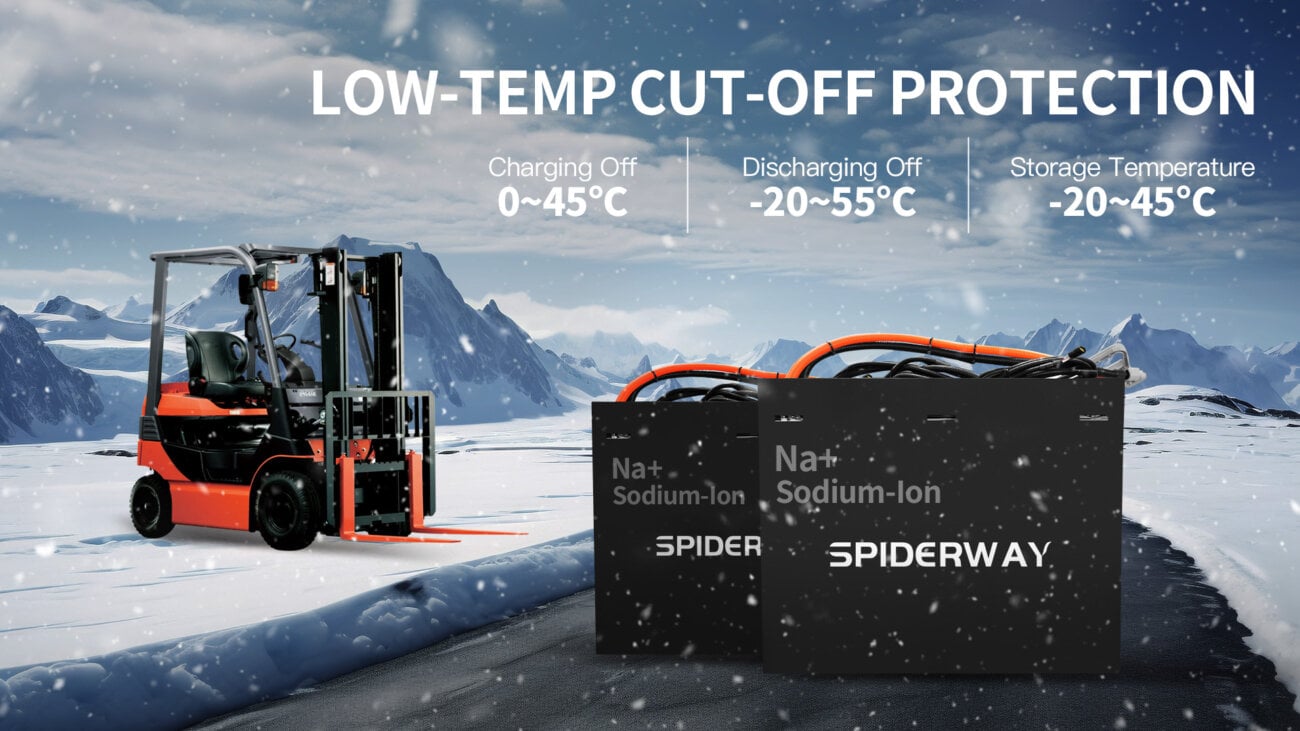
One of the most important considerations for Russian forklift operators is temperature. In many parts of Russia, winter temperatures can fall well below freezing. A forklift battery that performs well at 20–25°C may behave very differently at -10°C, -20°C, or below.
Sodium-ion battery chemistry has attracted attention because of its relatively favorable low-temperature characteristics. Compared with conventional lithium-ion systems, sodium-ion cells can maintain useful electrochemical performance over a wider low-temperature operating range, depending on the specific cell chemistry and design.

For forklift applications, this can provide several potential benefits:
- More stable power delivery in cold environments
- Reduced capacity loss compared with some conventional lithium-ion chemistries
- Better suitability for seasonal outdoor operations
- Reduced dependence on battery heating in certain operating conditions
- Improved reliability for cold-storage and winter logistics applications
However, battery performance is highly dependent on the specific cell formulation, BMS strategy, pack design, insulation, and thermal management system. Therefore, a sodium-ion forklift battery should not be described simply as “immune to cold.” Proper engineering remains essential.
Better Suitability for Cold Warehouses and Outdoor Forklift Operations
Russia has a large number of warehouses, industrial facilities, logistics centers, and outdoor storage yards where forklifts may encounter low ambient temperatures. Examples include:
Cold-storage warehouses
Food and pharmaceutical logistics may require forklifts to work in refrigerated environments.
Outdoor logistics yards
Forklifts operating outside may experience rapid temperature changes and prolonged exposure to winter conditions.
Manufacturing facilities
Metal, timber, construction-material, and industrial production facilities may operate in partially heated or unheated environments.
Regional distribution centers
Large Russian logistics networks can involve operations across regions with significantly different climates.
For these applications, sodium-ion battery technology can provide an alternative to conventional lead-acid and lithium-ion systems.

Sodium-Ion Batteries Use More Abundant Raw Materials
Another important consideration is the supply chain. Lithium-ion batteries depend on lithium and other critical battery materials. Depending on the chemistry, they may also require nickel, cobalt, graphite, or other materials. Sodium-ion technology uses sodium as the primary charge carrier.
Sodium is abundant and widely distributed globally. This creates potential advantages in terms of long-term raw-material availability and diversification of battery supply chains. For industrial battery users, this is strategically important. A forklift battery is not simply an energy-storage product; it is a long-term industrial asset that may remain in service for many years. Greater diversity in battery chemistry can help industrial customers reduce dependence on a single technology or material supply chain.
Safety Is Particularly Important for Industrial Forklifts
Forklifts operate in environments where batteries are exposed to vibration, mechanical stress, repeated charging, and demanding duty cycles. Battery safety therefore requires more than selecting a particular chemistry.
A complete industrial battery system should include:
- Battery Management System (BMS)
- Over-voltage protection
- Under-voltage protection
- Over-current protection
- Short-circuit protection
- Over-temperature protection
- Cell balancing
- Charging control
- Communication interfaces
- Mechanical protection
- Thermal management
Sodium-ion chemistry has several intrinsic characteristics that make it attractive for applications where safety and thermal stability are important. Nevertheless, the safety of a forklift battery ultimately depends on the entire battery system, including cell quality, electrical architecture, BMS programming, enclosure design, charger compatibility, and manufacturing quality. This is why professional battery engineering is more important than chemistry alone.
Fast Opportunity Charging Can Improve Forklift Productivity
One of the major differences between traditional lead-acid forklift batteries and modern lithium-based systems is charging strategy. Lead-acid forklift batteries often require long charging periods and may require battery replacement when continuous multi-shift operation is required.
A properly designed lithium or sodium-ion forklift battery can support opportunity charging, depending on the cell specification and BMS. For example, a logistics operation may recharge a forklift during:
- Lunch breaks
- Shift changes
- Scheduled downtime
- Warehouse maintenance periods
This can reduce the need for multiple battery sets and battery-changing infrastructure. For high-utilization Russian warehouses, this may contribute to higher equipment utilization + simpler battery logistics + reduced downtime. The actual charging rate must always follow the battery manufacturer’s specifications.
Lower Maintenance Compared With Lead-Acid Batteries
Lead-acid batteries have traditionally been widely used in forklifts. However, they require several maintenance procedures, including:

- Electrolyte monitoring
- Water replenishment
- Ventilation management
- Cleaning
- Battery equalization
- Regular inspection
Modern lithium-based forklift batteries are designed to eliminate many of these requirements. Sodium-ion forklift batteries can similarly be designed as maintenance-free battery systems. A sealed industrial battery pack can reduce routine battery maintenance and simplify fleet management. This can be particularly valuable for large Russian warehouses operating dozens or hundreds of electric forklifts.
Energy Efficiency and Total Cost of Ownership
Battery price is only one component of forklift operating cost. Fleet operators should evaluate Total Cost of Ownership (TCO). A complete TCO calculation may include:
- Battery purchase price
- Electricity consumption
- Charging losses
- Maintenance
- Battery replacement
- Labor
- Downtime
- Infrastructure
- Service costs
Lithium-based battery systems generally provide significantly higher charging efficiency than traditional lead-acid batteries. Sodium-ion technology aims to combine many of the operational advantages associated with modern lithium battery systems while potentially reducing exposure to lithium-related raw-material costs. However, the economic advantage depends on the application. For example, a low-utilization forklift may prioritize purchase price, while a three-shift distribution center may place much greater value on charging efficiency, battery life, uptime, and maintenance. Therefore, SPIDERWAY recommends evaluating sodium-ion forklift batteries based on application-specific TCO rather than battery purchase price alone.
Sodium-Ion vs. LiFePO₄ for Russian Forklift Applications
It is important to make a balanced comparison. LiFePO₄ remains one of the most mature lithium battery chemistries for industrial vehicles. Sodium-ion technology should therefore be viewed as an additional solution rather than an automatic replacement for LiFePO₄.
| Parameter | Sodium-Ion | LiFePO₄ | Lead-Acid |
|---|---|---|---|
| Low-temperature potential | Very good | Good with thermal management | Limited |
| Energy density | Generally lower | Higher | Low |
| Charging efficiency | High | High | Lower |
| Maintenance | Low | Low | High |
| Opportunity charging | Possible | Excellent | Limited |
| Thermal stability | Very good | Very good | Good |
| Raw-material availability | Excellent potential | Good | Mature |
| Industrial maturity | Emerging | Highly mature | Highly mature |
| Cold-climate potential | Strong | Strong with proper design | Weaker |
| Initial cost | Technology-dependent | Technology-dependent | Usually lower |
The most suitable technology depends on the forklift model, duty cycle, operating temperature, charging infrastructure, required runtime, and total cost of ownership.
SPIDERWAY Sodium-Ion Forklift Battery Solutions
As an industrial battery manufacturer, SPIDERWAY is developing sodium-ion battery systems specifically for demanding commercial and industrial applications. Our sodium-ion forklift battery solutions can be engineered around the requirements of different forklift platforms, including:
- Electric counterbalance forklifts
- Warehouse forklifts
- Reach trucks
- Pallet trucks
- Stackers
- Electric material-handling equipment
- Industrial vehicles
Rather than providing a generic battery pack, SPIDERWAY focuses on application-specific battery engineering. The battery system can be configured according to requirements such as:
Voltage
Common industrial battery platforms can be engineered around different voltage architectures depending on the forklift electrical system.

Capacity
Battery capacity can be customized according to required operating time, vehicle power consumption, and available battery compartment dimensions.
BMS
The Battery Management System can monitor:
- Cell voltage
- Pack voltage
- Current
- Temperature
- State of Charge (SOC)
- State of Health (SOH)
- Charging status
- Fault conditions
Communication
For modern intelligent forklifts, battery communication can be integrated with the vehicle controller through appropriate communication protocols.
Mechanical Integration
SPIDERWAY can engineer battery dimensions, connectors, mounting structures, cable configuration, and enclosure design around the target forklift.
OEM and ODM Sodium-Ion Forklift Battery Manufacturing
Russian forklift distributors, fleet operators, equipment manufacturers, and battery importers may have different technical requirements. For this reason, SPIDERWAY provides OEM and ODM battery engineering services.
Our engineering process can include:
Application analysis → Battery specification → Cell selection → Electrical design → BMS development → Mechanical design → Prototype → Testing → Production
The engineering team can evaluate:
- Forklift model
- Existing battery dimensions
- Voltage
- Ah capacity
- Maximum discharge current
- Charger specifications
- Communication requirements
- Operating temperature
- Duty cycle
- Required runtime
- Battery compartment
- Connector configuration
- Mounting method
This approach allows the sodium-ion battery pack to be designed around the forklift rather than forcing the forklift to adapt to a standardized battery.

Important Considerations Before Choosing Sodium-Ion Forklift Batteries
Despite its advantages, sodium-ion technology is not suitable for every forklift application. Several factors should be evaluated before deployment.
Energy density
Sodium-ion batteries generally have lower energy density than some lithium-ion alternatives. Battery compartment space therefore needs to be considered carefully.
Charging compatibility
The charger must be compatible with the battery’s voltage, charging current, charging profile, and BMS requirements.
Low-temperature charging
Although sodium-ion batteries can offer strong low-temperature performance, charging at extremely low temperatures must still follow the specific cell manufacturer’s operating specifications.
Cell availability
The sodium-ion battery supply chain is still developing compared with mature LiFePO₄ supply chains.
Application requirements
High-energy-density applications may still favor LiFePO₄ or other lithium-ion technologies. For this reason, SPIDERWAY recommends conducting a technical assessment before selecting the final battery chemistry.
Why Sodium-Ion Technology Could Be Valuable for Russia
From an engineering perspective, the strongest case for sodium-ion forklift batteries in Russia is not simply that they are “better batteries.” The more important question is: Which battery chemistry provides the best combination of performance, reliability, safety, cost, and supply-chain resilience for a specific Russian industrial application?
For certain applications, sodium-ion technology offers an attractive combination of:
- Strong low-temperature characteristics
- High charging efficiency
- Low maintenance
- Good safety potential
- Opportunity-charging capability
- Abundant sodium resources
- Reduced dependence on lithium raw materials
- Potential suitability for demanding industrial environments
These characteristics make sodium-ion technology particularly worth evaluating for Russian forklift fleets operating in cold climates.
SPIDERWAY: Engineering Battery Solutions for Industrial Vehicles
SPIDERWAY is an industrial lithium and sodium-ion battery manufacturer focused on power solutions for material-handling equipment and industrial vehicles. Our product and engineering capabilities cover applications including:
- Forklift batteries
- Warehouse equipment batteries
- Golf cart batteries
- AWP batteries
- AGV/AMR batteries
- Ground Support Equipment (GSE) batteries
- Industrial vehicle batteries
- Custom battery packs
- Battery chargers
- BMS and power electronics
For Russian customers, SPIDERWAY can provide custom sodium-ion forklift battery development, OEM manufacturing, ODM engineering, and application-specific battery solutions.
Rather than promoting one chemistry for every application, our engineering approach is to evaluate the forklift, working environment, duty cycle, charging conditions, and expected service life first—and then determine whether sodium-ion, LiFePO₄, or another battery technology is the technically and economically appropriate choice.
Conclusion: Are Sodium-Ion Forklift Batteries Suitable for Russia?
Sodium-ion forklift batteries have several characteristics that make them particularly interesting for the Russian market, especially for applications exposed to low temperatures, demanding operating schedules, and the need for reliable industrial energy storage.
Their potential advantages include favorable cold-weather performance, high charging efficiency, low maintenance, good safety characteristics, and access to abundant sodium-based raw materials.
At the same time, sodium-ion technology is still developing. Lower energy density, evolving cell supply chains, and application-specific charging requirements mean that it should be evaluated carefully rather than treated as a universal replacement for LiFePO₄.
For Russian forklift manufacturers, distributors, and fleet operators, the most practical approach is to compare sodium-ion and LiFePO₄ forklift batteries according to actual operating conditions and total cost of ownership.
With its experience in industrial battery engineering and OEM/ODM manufacturing, SPIDERWAY can help customers evaluate and develop customized sodium-ion forklift battery systems for cold-climate and demanding material-handling applications.
Supplier & Author Profile

- SpiderwayVerified
SPIDERWAY is a trusted LiFePO4 battery manufacturer specializing in golf cart, marine, RV, solar energy storage, industrial, and custom lithium battery solutions. We deliver OEM/ODM services, factory-direct quality, global shipping, and expert support for distributors, brands, and wholesale buyers worldwide.
Latest entries
- 2026-09-17Liquid-Cooled LiFePO4 Battery Packs for Heavy-Duty Electric Machinery
- 2026-09-16598.92V 180.87kWh High-Voltage Lithium Battery System for Heavy-Duty Electric Machinery
- 2026-09-08Exploring SPIDERWAY’s LiFePO4 Battery Plant in Hefei: A Look Inside an Advanced Industrial Lithium Battery Production Line
- 2026-09-08Evolution of LiFePO4 Battery Energy Density: A Decade of Advances and Future Outlook (2015–2035)