LiFePO₄ Lithium Batteries in Modern Warehousing and Logistics: Powering the Next Generation of Material Handling
Introduction: Why Battery Technology Matters in Modern Warehousing
Modern warehousing and logistics operations are under constant pressure to move more goods, reduce operating costs, improve equipment availability, and meet increasingly demanding sustainability targets. At the center of this transformation is the electrification of material handling equipment.
Electric forklifts, pallet trucks, reach trucks, stackers, automated guided vehicles (AGVs), autonomous mobile robots (AMRs), tow tractors, and other warehouse vehicles increasingly depend on lithium-ion battery technology to deliver reliable power throughout demanding operating cycles.
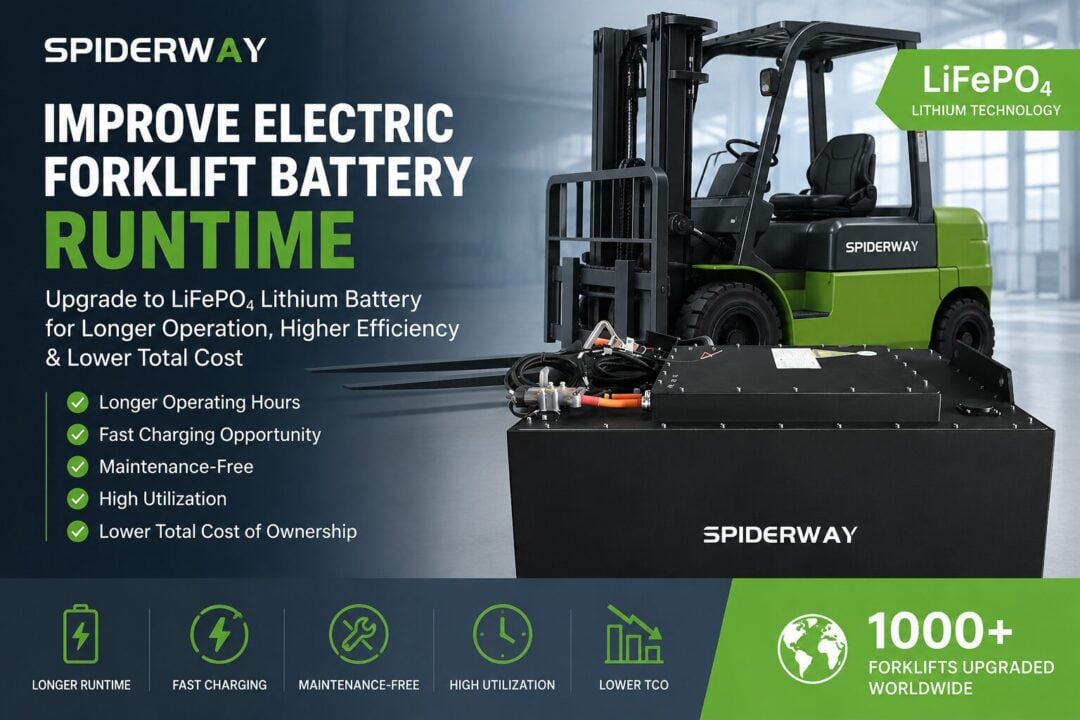
Among the available lithium-ion chemistries, lithium iron phosphate (LiFePO₄ or LFP) has become particularly attractive for industrial applications because it combines strong thermal stability, long cycle life, high usable energy, low maintenance requirements, and suitability for frequent charging.
For warehouses and logistics facilities operating multiple shifts, these characteristics can fundamentally change the economics of battery-powered material handling.
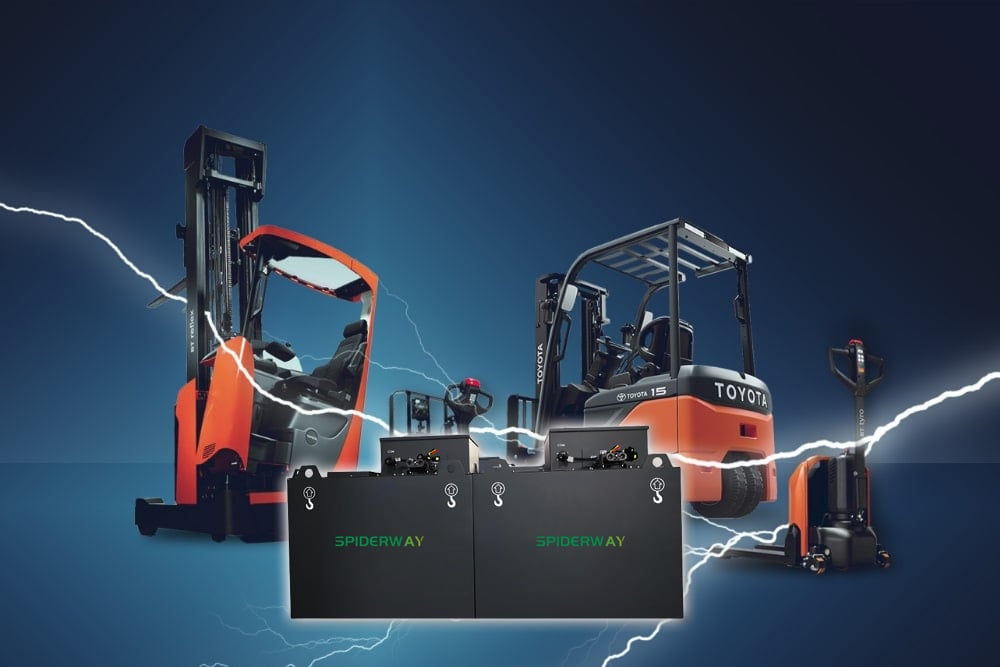
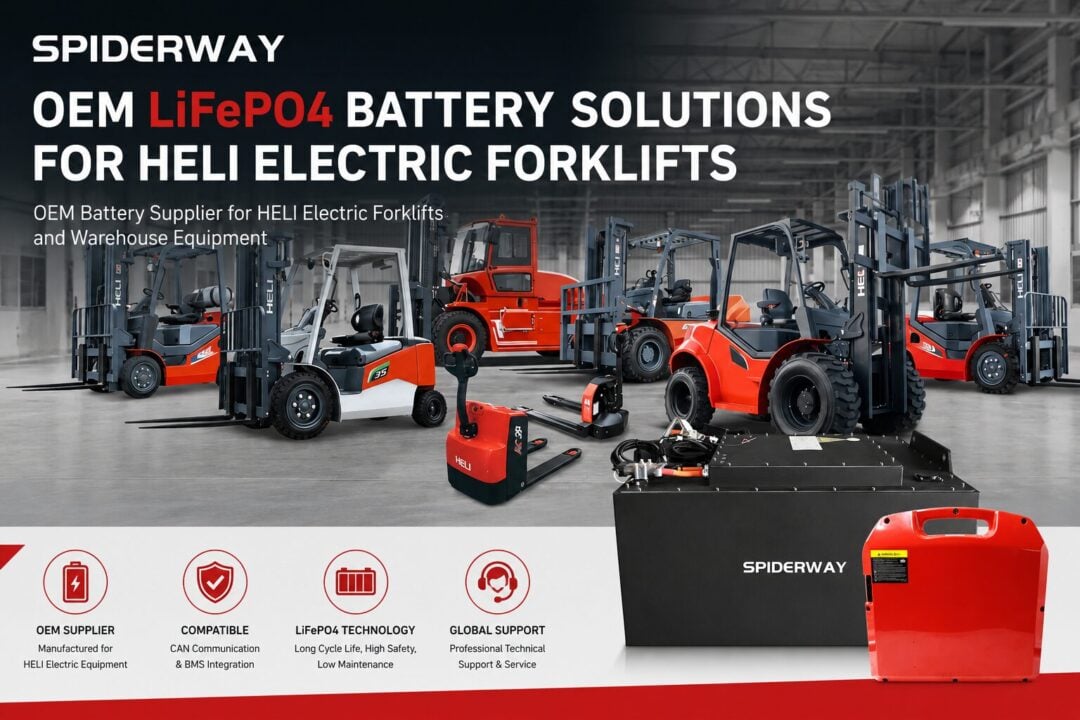
SPIDERWAY specializes in LiFePO₄ lithium battery technology for industrial vehicles and material handling applications. The company provides batteries and customized power solutions for applications including forklifts, pallet trucks, AGVs, GSE, aerial work platforms, and other industrial equipment. Its positioning is not simply as a battery supplier, but as a professional material handling and warehouse logistics battery manufacturer and solution provider.
1. The Evolution of Power Systems in Material Handling
Traditionally, electric material handling equipment relied heavily on lead-acid batteries. Lead-acid technology remains widely used because of its relatively low initial purchase price and established infrastructure.
However, the operational requirements of modern warehouses have changed significantly.
A high-throughput distribution center may operate equipment for extended periods, sometimes across two or three shifts per day. Under these conditions, the limitations of conventional lead-acid batteries become increasingly important:
- Long charging times
- Significant downtime during battery charging
- Requirement for dedicated battery charging and storage areas
- Regular watering and maintenance
- Performance degradation as the battery ages
- Reduced available power as state of charge decreases
- Heavy battery weight
- Limited opportunity charging capability
- Shorter effective service life under intensive cycling
LiFePO₄ lithium batteries address many of these operational challenges.
Instead of designing warehouse operations around the limitations of the battery, lithium battery systems allow the battery to become an integrated part of a more flexible energy-management strategy.
2. What Is a LiFePO₄ Battery?
LiFePO₄ stands for lithium iron phosphate, a lithium-ion battery chemistry that uses lithium iron phosphate as the cathode material.
Compared with some other lithium-ion chemistries, LFP is particularly attractive for industrial applications because of its strong thermal and chemical stability.
A typical LiFePO₄ industrial battery system consists of:
- LiFePO₄ battery cells
- Battery management system (BMS)
- High-voltage or low-voltage protection components
- Current sensors
- Contactors and fuses
- Communication interfaces
- Battery enclosure
- Charging interface
- Monitoring and diagnostic functions
The battery should therefore be viewed as more than a collection of cells.
For material handling applications, the battery system, BMS, charger, vehicle controller, mechanical integration, and operating strategy all contribute to actual performance.
This is one reason why selecting an experienced industrial lithium battery manufacturer is important.
3. Why LiFePO₄ Is Well Suited to Material Handling Equipment
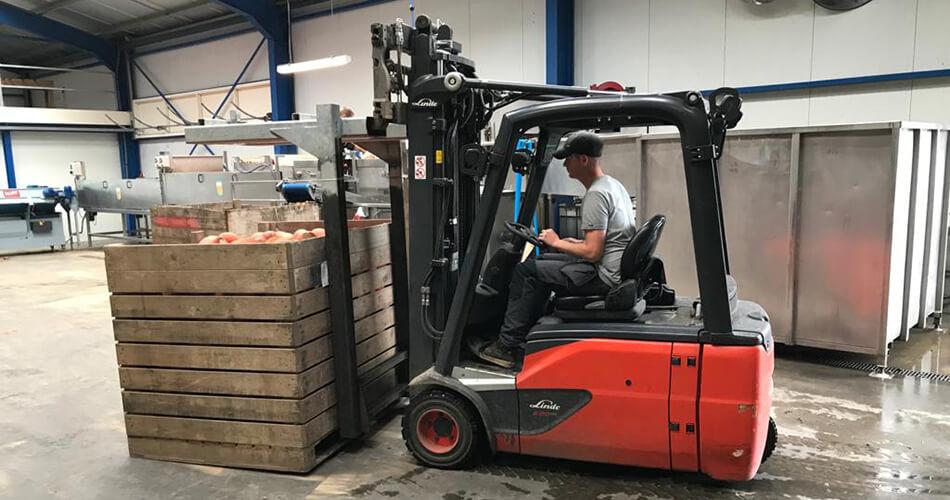
Material handling equipment has a very different duty cycle from passenger electric vehicles.
A forklift in a distribution center may repeatedly accelerate, lift loads, travel short distances, stop, idle, and recharge throughout the day. A warehouse AGV may operate continuously according to a predefined logistics schedule.
These applications place considerable demands on the battery.
LiFePO₄ technology offers several characteristics that align well with this operating environment.
3.1 Long Cycle Life
One of the most important advantages of LiFePO₄ batteries is their potential for long cycle life.
Industrial equipment can experience hundreds or thousands of charging and discharging cycles over its service life. A battery with a longer cycle life can reduce the frequency of battery replacement and help lower long-term operating costs.
However, cycle life should never be evaluated as a single marketing number.
Actual battery life depends on factors such as:
- Depth of discharge
- Charging current
- Operating temperature
- Cell quality
- BMS strategy
- Charge voltage
- Discharge rate
- Storage conditions
- Mechanical and electrical design
For this reason, professional battery manufacturers should evaluate the customer’s actual duty cycle rather than simply recommending a battery based on voltage and amp-hour capacity.
4. Fast Charging and Opportunity Charging
One of the biggest operational advantages of lithium batteries in warehouses is the ability to support opportunity charging.
Traditional lead-acid batteries often require long charging periods followed by cooling time before they can return to demanding operation.
Lithium battery systems can be designed for much more flexible charging strategies.
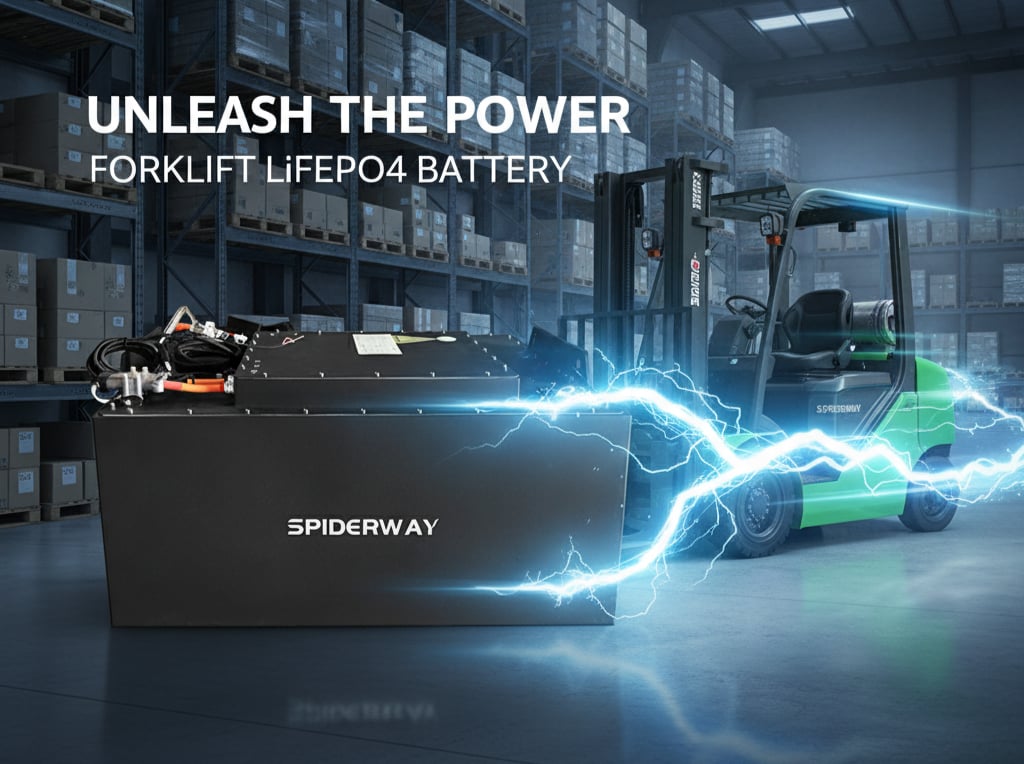
For example, an electric forklift may be charged during:
- Scheduled breaks
- Meal periods
- Shift changes
- Equipment waiting periods
- Low-demand periods
- Planned maintenance intervals
Instead of removing a battery and replacing it with another fully charged battery, operators can potentially keep the same battery installed and use short charging windows throughout the working day.
This can significantly simplify fleet management.
A Practical Example
Consider a warehouse operating electric forklifts across multiple shifts.
With conventional battery management, the operator may need:
Forklift → depleted battery → battery replacement → charging room → spare battery
With an opportunity-charging strategy:
Forklift → short charging period → return to operation
This can reduce the need for spare batteries and battery-changing infrastructure.
The exact charging strategy must, however, be designed around the battery specification, charger, BMS, vehicle manufacturer requirements, and actual duty cycle.
5. Higher Equipment Availability
In logistics, equipment availability directly influences productivity.
A forklift that is unavailable during a critical loading period can create a chain reaction affecting:
- Warehouse picking
- Pallet movement
- Loading and unloading
- Production feeding
- Order fulfillment
- Truck scheduling
- Distribution center throughput
Lithium batteries can help increase equipment availability because they support faster and more flexible charging while eliminating many routine maintenance tasks associated with flooded lead-acid batteries.
For high-utilization fleets, this can be one of the most important economic benefits.
6. No Routine Watering
Flooded lead-acid batteries require regular watering because electrolyte levels must be maintained.
LiFePO₄ batteries do not require this type of routine watering.
This reduces maintenance work and eliminates the need to manage battery watering procedures in the same way as conventional flooded lead-acid systems.
For large warehouses operating dozens or hundreds of electric vehicles, reducing battery maintenance can provide meaningful operational benefits.
It also simplifies the workflow for warehouse personnel who are primarily responsible for logistics rather than battery maintenance.
7. Consistent Power Performance
Battery performance affects more than operating time.
For material handling equipment, battery voltage behavior can influence:
- Traction performance
- Hydraulic lifting performance
- Acceleration
- Controller operation
- Operator experience
- Equipment productivity
A well-designed lithium battery system can provide relatively stable voltage throughout a substantial portion of its usable state-of-charge range.
This is particularly useful for forklifts and other equipment where consistent power delivery is important.
For example, maintaining reliable power during lifting operations can help operators perform their tasks without the noticeable performance reduction that can occur as conventional batteries become heavily discharged.
8. Lower Battery Maintenance Requirements
A lithium battery system generally requires substantially less routine maintenance than a flooded lead-acid battery.
A professional LiFePO₄ battery system may incorporate intelligent monitoring of:
- Cell voltage
- Pack voltage
- Current
- Temperature
- State of charge (SOC)
- State of health (SOH)
- Charging status
- Fault conditions
The BMS can provide protection against abnormal operating conditions and help operators understand the battery’s condition.
This creates a shift from maintenance-intensive battery management toward data-driven battery management.
For modern smart warehouses, this is especially valuable.
9. Battery Management System: The Intelligence Behind a Lithium Battery
The BMS is one of the most important components of an industrial lithium battery.
A high-quality LiFePO₄ cell alone does not guarantee a high-quality battery system.
The BMS may perform functions such as:
- Overcharge protection
- Over-discharge protection
- Overcurrent protection
- Short-circuit protection
- Temperature monitoring
- Cell voltage monitoring
- Cell balancing
- State-of-charge estimation
- Fault detection
- Communication with the vehicle
- Communication with the charger
For advanced material handling applications, communication between the battery and vehicle can be particularly important.
A properly integrated BMS can help ensure that the battery, charger, and vehicle work as one coordinated system rather than as independent components.
10. LiFePO₄ Battery Safety for Warehouse Applications
Safety is one of the most important considerations when selecting an industrial battery.
Warehouses contain high-value inventory, employees, vehicles, charging infrastructure, and automated systems. Battery incidents can therefore have consequences far beyond the battery itself.
LiFePO₄ chemistry is widely regarded as one of the more thermally stable lithium-ion chemistries.
Its strong thermal stability and chemical characteristics make it particularly attractive for industrial environments.
Nevertheless, battery safety is not determined by chemistry alone.
A safe industrial lithium battery requires appropriate:
- Cell selection
- Electrical design
- BMS protection
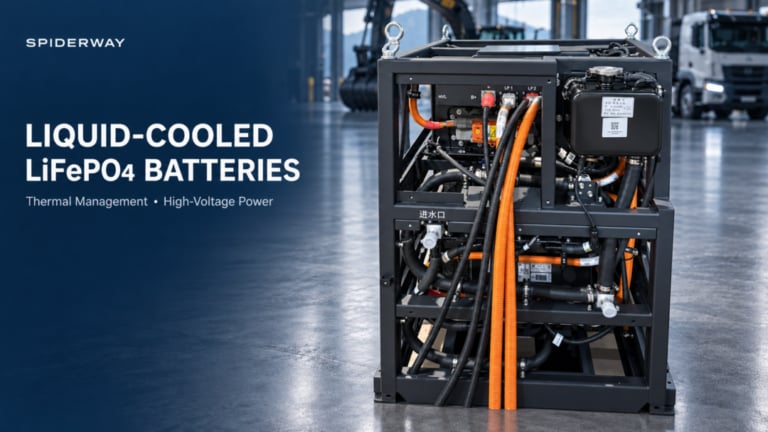
- Thermal management
- Mechanical protection
- Wiring
- Fusing
- Charging control
- Enclosure design
- Manufacturing quality
- Testing and validation
This distinction is important when comparing industrial lithium battery suppliers.
A low-cost battery assembled from unknown components may not provide the same level of system reliability as a professionally engineered industrial battery.
11. Energy Efficiency and Total Cost of Ownership
The initial purchase price of a lithium battery is typically only one component of its overall economic value.
For warehouse operators, the more meaningful metric is often total cost of ownership (TCO).
TCO can include:
Battery purchase + charging infrastructure + maintenance + downtime + battery replacement + labor + energy consumption + operational losses
LiFePO₄ batteries can potentially reduce several of these costs through:
- Longer service life
- Lower maintenance requirements
- Opportunity charging
- Reduced battery-change labor
- Higher equipment availability
- Improved energy utilization
- Reduced need for spare batteries
The actual financial result depends on the operating profile.
A low-utilization forklift may not produce the same return on investment as a three-shift distribution-center fleet.
Therefore, battery selection should be based on duty-cycle economics rather than simply purchase price.
12. LiFePO₄ Batteries for Electric Forklifts
Forklifts are one of the most important applications for industrial LiFePO₄ batteries.
SPIDERWAY develops lithium battery solutions for electric forklift applications, including batteries designed around different voltage, capacity, physical dimensions, communication, and performance requirements.
Typical forklift battery requirements may include:
- 24V systems
- 36V systems
- 48V systems
- 72V systems
- 80V systems
The correct configuration depends on the forklift model, motor system, controller, hydraulic requirements, operating hours, load profile, and available installation space.
For example, a high-capacity battery for a heavy-duty warehouse forklift may require a completely different engineering approach from a compact battery used in an electric pallet truck.
This is why industrial lithium battery customization is an important part of the material handling market.
13. LiFePO₄ Batteries for Electric Pallet Trucks
Electric pallet trucks typically require compact, reliable, and lightweight power systems.
Applications include:
- Warehouse pallet movement
- Retail distribution
- Loading docks
- Manufacturing facilities
- Cold-chain logistics
- E-commerce fulfillment centers
For these vehicles, battery dimensions and connector configuration can be just as important as energy capacity.
A properly designed lithium battery can provide a compact replacement solution while supporting frequent charging and intensive daily operation.
14. LiFePO₄ Batteries for Reach Trucks and Stackers
Reach trucks and electric stackers operate in environments where precision, reliability, and equipment availability are critical.
A battery failure during a busy warehouse shift can interrupt pallet movement and affect inventory flow.
LiFePO₄ battery systems can provide:
- Stable power delivery
- Long service life
- Flexible charging
- Reduced routine maintenance
- Intelligent battery monitoring
- Custom mechanical integration
For narrow-aisle warehouses and high-density storage facilities, these advantages can be especially valuable.
15. LiFePO₄ Batteries for AGVs and AMRs
The development of automated warehouses is creating new requirements for industrial batteries.
Automated Guided Vehicles (AGVs) and Autonomous Mobile Robots (AMRs) may operate for long periods with limited human intervention.
Their batteries must therefore support:
- High operating availability
- Predictable energy consumption
- Automated charging
- Accurate SOC estimation
- Communication with fleet-management systems
- Reliable repeated cycling
LiFePO₄ technology is well suited to these requirements when properly integrated with the vehicle’s electrical and software architecture.
For automated logistics systems, battery communication becomes increasingly important because the battery is no longer simply an energy-storage device. It becomes a connected energy-management component within the automation system.
16. Cold Storage and Temperature-Challenging Environments
Cold-chain warehouses present additional battery challenges.
Low temperatures can affect battery chemistry, available power, charging behavior, and usable capacity.
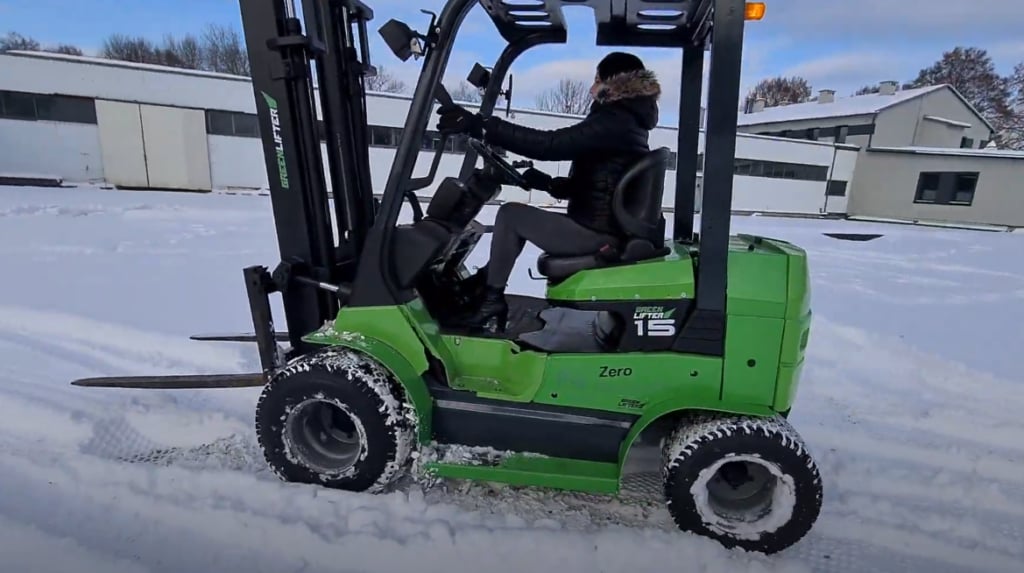
Therefore, a lithium battery intended for cold-storage applications should not simply use the same configuration designed for a normal-temperature warehouse.
Depending on the application, the battery system may require:
- Low-temperature charging protection
- Temperature monitoring
- Thermal management
- Heating functions
- Customized BMS parameters
- Appropriate charging strategies
This is an area where application engineering is particularly important.
A professional industrial battery manufacturer should evaluate the operating temperature range before specifying the final battery configuration.
17. Compact Design and Better Use of Warehouse Space
Warehouse space is expensive.
Traditional lead-acid battery systems may require dedicated charging areas, ventilation considerations, battery-changing infrastructure, and spare battery storage.
Lithium battery systems can simplify the battery infrastructure and potentially reduce the amount of space dedicated to battery operations.
This can allow warehouse operators to allocate more floor space to:
- Inventory
- Storage racks
- Picking areas
- Packaging
- Production
- Automated equipment
In a high-value logistics facility, recovering usable floor space can create an economic benefit beyond the battery itself.
18. LiFePO₄ vs. Lead-Acid Batteries for Material Handling
| Feature | LiFePO₄ Lithium Battery | Lead-Acid Battery |
|---|---|---|
| Charging flexibility | Excellent for opportunity charging | More limited |
| Routine watering | Not required | Required for flooded types |
| Maintenance | Low | Higher |
| Cycle life | Generally longer | Generally shorter |
| Energy efficiency | High | Lower |
| Power consistency | Strong | Can decline with state of charge |
| Battery changing | Often unnecessary with suitable charging strategy | Common in intensive operations |
| Charging time | Potentially much shorter | Generally longer |
| Battery weight | Lower for equivalent usable energy in many applications | Heavy |
| BMS intelligence | Standard in properly engineered systems | Generally less sophisticated |
| Multi-shift operation | Highly suitable | Requires careful battery management |
| Initial purchase cost | Usually higher | Usually lower |
| Long-term TCO | Potentially lower | Can be higher under intensive use |
The key point is that lithium batteries are not automatically the best choice for every application.
For low-utilization equipment, lead-acid may still make economic sense.
For high-utilization warehouses, however, the operational advantages of LiFePO₄ can make the total cost equation much more attractive.
19. How to Select the Right LiFePO₄ Battery for a Warehouse
Selecting a warehouse battery should begin with the equipment and duty cycle rather than the battery catalog.
Important parameters include:
1. Equipment Type
Identify whether the battery will be used in:
- Forklifts
- Reach trucks
- Stackers
- Pallet trucks
- AGVs
- AMRs
- Tow tractors
- Cleaning machines
- Other industrial vehicles
2. Nominal Voltage
The battery must match the vehicle’s electrical architecture.
Common industrial configurations include 24V, 36V, 48V, 72V, and 80V systems.
3. Battery Capacity
Capacity should be determined according to:
- Operating hours
- Load
- Travel distance
- Lift frequency
- Motor power
- Environmental conditions
- Charging opportunities
4. Peak Current
A battery must be capable of supplying the required current during acceleration, lifting, and other high-load conditions.
5. Charging Strategy
Determine whether the operation requires:
- Overnight charging
- Standard charging
- Fast charging
- Opportunity charging
- Automated charging
6. Communication
Modern industrial batteries may need CAN bus or other communication interfaces to communicate with:
- Vehicle controllers
- Chargers
- Fleet-management systems
- Monitoring platforms
7. Physical Dimensions
The battery must fit the original battery compartment while maintaining appropriate mechanical protection and connection points.
20. Why Battery Engineering Is More Important Than Battery Cells Alone
When purchasing an industrial LiFePO₄ battery, buyers often focus on the battery cells.
Cell quality is important, but it is only one part of the equation.
An industrial battery should be evaluated as a complete system.
The real engineering challenge lies in integrating:
Cells + BMS + electrical protection + enclosure + thermal management + connectors + communication + charger + vehicle
This is particularly important for OEM replacement projects.
A battery that has the correct voltage and capacity on paper may still fail to deliver the expected performance if the BMS communication, discharge current, connector configuration, dimensions, or charging protocol are incompatible with the vehicle.
Therefore, industrial battery procurement should involve technical verification before mass deployment.
21. SPIDERWAY: A Professional LiFePO₄ Battery Manufacturer for Material Handling
SPIDERWAY focuses on industrial LiFePO₄ lithium battery technology and provides power solutions for industrial vehicles and equipment.
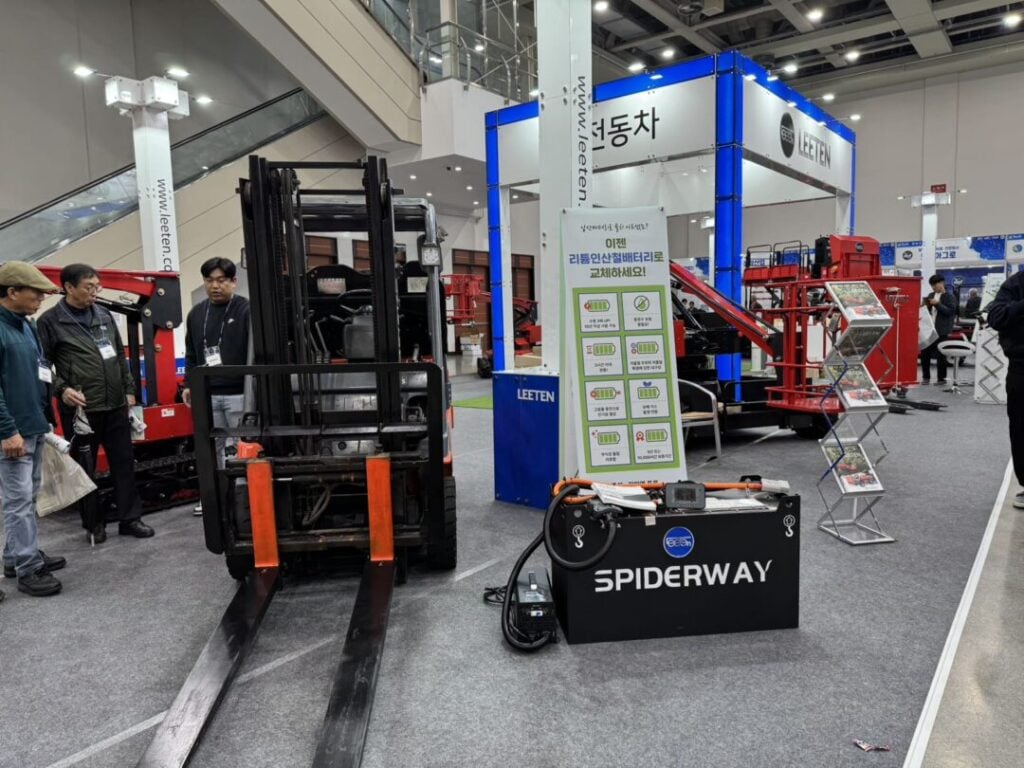
The company’s product portfolio covers applications including:
- Electric forklift batteries
- Material handling batteries
- Golf cart batteries
- Ground support equipment (GSE) batteries
- Aerial work platform (AWP) batteries
- AGV and industrial vehicle batteries
- Customized LiFePO₄ battery systems
SPIDERWAY’s industrial battery solutions are designed around real application requirements rather than treating every battery as a standardized commodity.
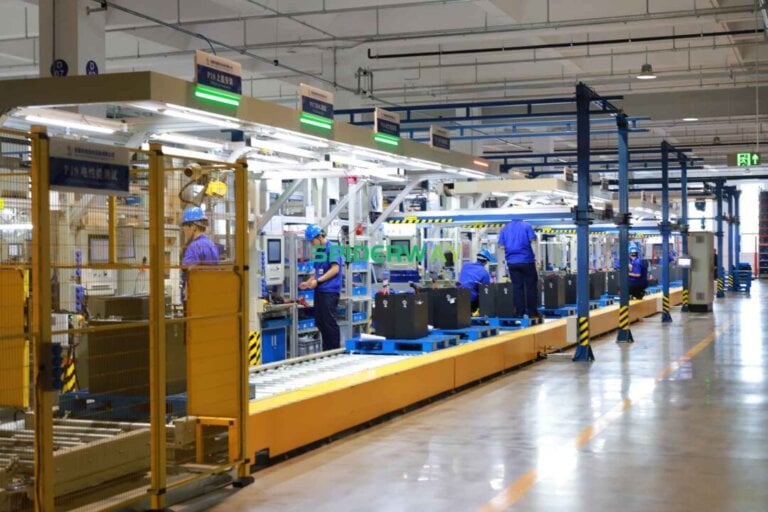
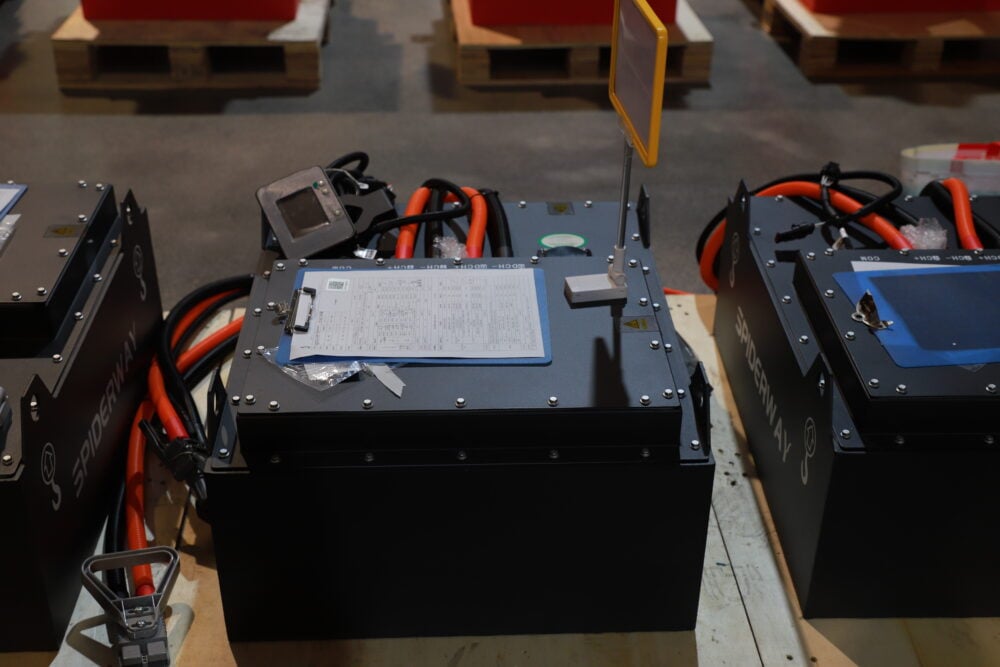
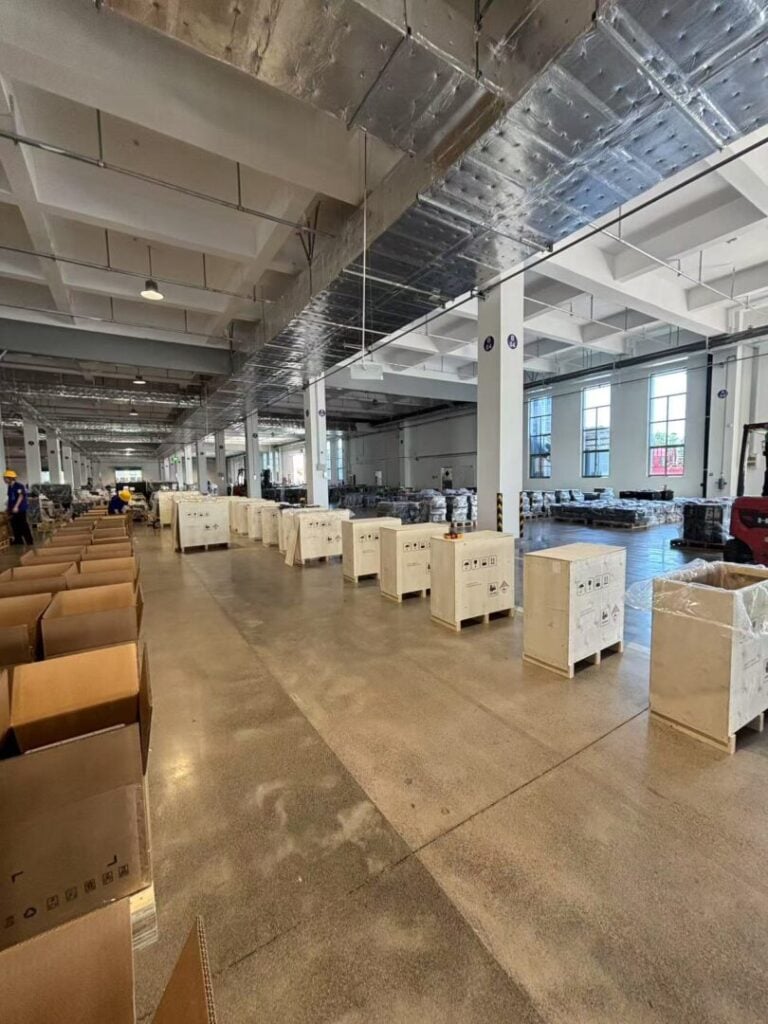
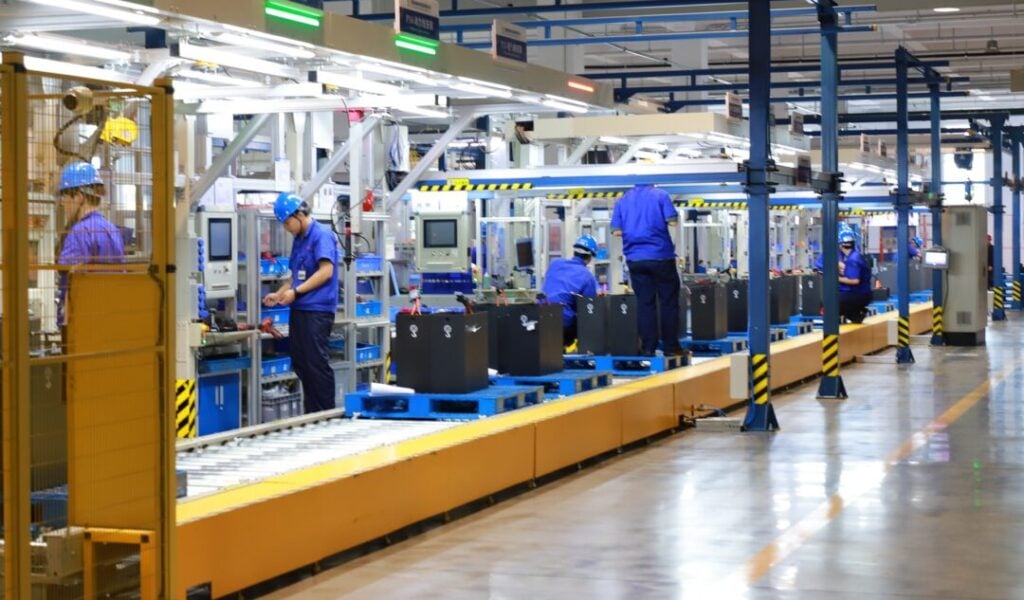
The company describes itself as a professional LiFePO₄ lithium battery manufacturer and supplier based in Hefei, Anhui, with experience in OEM/ODM lithium battery solutions for industrial vehicles. Its published industrial battery applications include forklifts, GSE, AWP, and other electric industrial vehicles.
This application-oriented approach is particularly important for warehouse and logistics customers.
22. SPIDERWAY as a Material Handling Battery Solution Provider
For warehouse operators, equipment manufacturers, distributors, and fleet managers, buying a lithium battery is only the beginning.
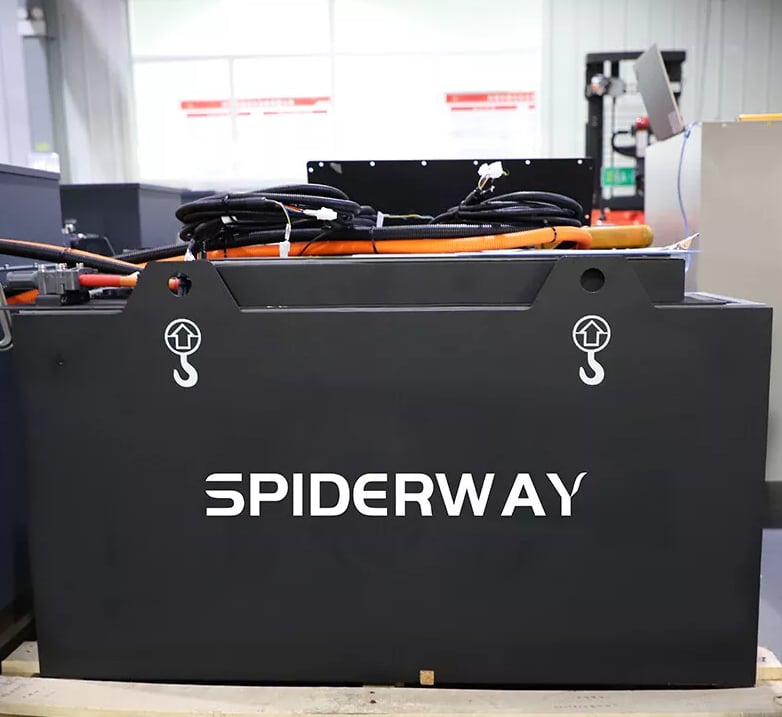
The more important question is:
Can the battery supplier provide the right solution for the application?
SPIDERWAY’s approach focuses on customized industrial battery solutions, including:
Battery Specification Engineering
The battery can be configured around the customer’s required voltage, capacity, current, dimensions, and operating conditions.
BMS Integration
Battery management parameters can be designed according to the requirements of the vehicle and application.
OEM/ODM Support
For equipment manufacturers and battery distributors, customized battery development can help support different vehicle platforms.
Industrial Application Experience
The company focuses on industrial vehicles rather than only consumer lithium battery applications.
Global Supply Capability
SPIDERWAY serves customers in international markets and positions its industrial lithium battery business around global supply and application support.
For companies electrifying material handling fleets, this combination of manufacturing capability and application engineering can be more valuable than simply purchasing off-the-shelf battery packs.
23. From Battery Replacement to Fleet Electrification
The future of warehouse battery procurement is moving beyond simple replacement.
A traditional approach asks:
“What battery can replace my existing battery?”
A more advanced approach asks:
“How can the battery system improve the productivity and economics of my entire material handling fleet?”
This second approach considers:
- Equipment utilization
- Number of shifts
- Charging infrastructure
- Electricity costs
- Battery replacement cycles
- Maintenance labor
- Fleet availability
- Warehouse layout
- Automation requirements
- Future equipment expansion
This is where an experienced material handling lithium battery manufacturer can add substantial value.
24. The Role of LiFePO₄ Batteries in Smart Warehouses
The warehouse of the future is increasingly connected.
Warehouse Management Systems (WMS), Warehouse Control Systems (WCS), fleet-management platforms, AGVs, AMRs, automated storage and retrieval systems, and industrial IoT devices are increasingly interconnected.
Battery systems are becoming part of this ecosystem.
A smart industrial battery can provide data related to:
- State of charge
- Battery temperature
- Charging status
- Fault conditions
- Battery health
- Usage history
- Cycle information
This data can potentially support predictive maintenance and fleet optimization.
Instead of waiting for a battery to fail, operators can use battery data to identify abnormal behavior and schedule maintenance proactively.
25. Sustainability Benefits of LiFePO₄ Battery Adoption
Warehouse electrification is not only about productivity.
Many companies are also pursuing environmental objectives across their logistics operations.
Replacing internal combustion engine equipment with electric alternatives can help reduce local exhaust emissions and improve indoor air quality.
LiFePO₄ batteries can further contribute to the sustainability strategy through:
- Long service life
- Reduced battery replacement frequency
- High energy efficiency
- Lower routine maintenance requirements
- Support for electric material handling equipment
- Compatibility with renewable-energy charging strategies
When combined with solar power or other renewable electricity sources, electric warehouse fleets can become part of a broader low-carbon energy strategy.
However, environmental performance should always be evaluated across the complete battery life cycle, including manufacturing, charging, service life, and end-of-life management.
26. The Future of Warehouse and Logistics Batteries
Several trends are likely to influence industrial battery technology in the coming years.
Higher Charging Speeds
As warehouse utilization increases, faster charging will become increasingly valuable.
Smarter BMS Systems
BMS technology will increasingly provide more accurate battery health information and communication capabilities.
Greater Integration with Fleet Management
Battery data can become part of fleet-management and predictive-maintenance systems.
More Automated Charging
AGVs, AMRs, and automated forklifts will increasingly require automated charging solutions.
Greater Battery Customization
Different warehouse vehicles will require application-specific battery configurations rather than standardized battery packs.
Battery-as-a-Service Models
High-utilization fleets may increasingly evaluate battery service models based on operating hours, energy consumption, or fleet utilization rather than simply purchasing batteries.
These developments reinforce the importance of selecting a battery supplier capable of supporting both today’s requirements and tomorrow’s electrification strategy.
27. Conclusion: LiFePO₄ Is Becoming a Strategic Power Solution for Material Handling
The transformation of warehousing and logistics is creating higher demands for reliable, efficient, and intelligent power systems.
For electric forklifts, pallet trucks, reach trucks, stackers, AGVs, AMRs, and other material handling equipment, LiFePO₄ lithium batteries offer a compelling combination of long cycle life, high thermal stability, low maintenance requirements, flexible charging, consistent power delivery, and potentially lower total cost of ownership.
The greatest advantage, however, is not simply the battery chemistry.
The real value comes from combining:
Reliable LiFePO₄ cells + intelligent BMS + appropriate charging + application-specific engineering + fleet-level energy management.
For high-utilization warehouses and logistics operations, this integrated approach can help reduce downtime, simplify battery management, improve equipment availability, and support the transition toward smarter and more sustainable material handling.
As a professional LiFePO₄ lithium battery manufacturer and material handling battery solution provider, SPIDERWAY is positioned to support this transition with industrial battery systems for forklifts and other electric industrial vehicles, together with OEM/ODM and application-oriented engineering capabilities.
For warehouse operators, logistics companies, equipment manufacturers, and material handling distributors evaluating lithium battery technology, the most important question is no longer simply which battery has the lowest purchase price?
The better question is:
Which LiFePO₄ battery solution can deliver the best combination of safety, productivity, service life, charging flexibility, integration, and total cost of ownership for the actual material handling application?
That is the foundation of modern industrial battery engineering—and the direction in which warehouse and logistics electrification is moving.
SPIDERWAY — Professional LiFePO₄ Lithium Battery Manufacturer and Material Handling Power Solution Provider.
Frequently Asked Questions About LiFePO₄ Batteries for Material Handling
Is LiFePO₄ suitable for forklift batteries?
Yes. LiFePO₄ is well suited to many electric forklift applications because of its thermal stability, long cycle life, low maintenance requirements, and compatibility with frequent charging strategies. The final battery specification should be matched to the forklift’s voltage, capacity, current, dimensions, BMS communication, and duty cycle.
Are LiFePO₄ forklift batteries better than lead-acid batteries?
For intensive material handling operations, LiFePO₄ can provide significant operational advantages, including faster and more flexible charging, reduced maintenance, longer service life, and improved equipment availability. However, the economic advantage depends on the specific utilization and operating profile.
Can LiFePO₄ forklift batteries support multiple shifts?
Yes. With an appropriately designed charging strategy, LiFePO₄ batteries can support intensive multi-shift operations and opportunity charging. Battery capacity and charging power should be selected according to the actual duty cycle.
Do LiFePO₄ forklift batteries require watering?
No. LiFePO₄ batteries do not require the routine electrolyte watering associated with flooded lead-acid batteries.
Can SPIDERWAY customize LiFePO₄ batteries for forklifts?
SPIDERWAY provides industrial LiFePO₄ battery solutions and OEM/ODM capabilities. Customization can address parameters such as voltage, capacity, dimensions, current capability, BMS configuration, communication, connectors, and application requirements.
What material handling equipment can use SPIDERWAY lithium batteries?
SPIDERWAY’s industrial battery portfolio covers applications including electric forklifts and other industrial vehicles, with related applications including GSE, AWP, and AGV/industrial vehicle systems.
What should I provide when requesting a LiFePO₄ forklift battery?
For an accurate battery recommendation, provide the forklift brand and model, existing battery voltage and capacity, battery compartment dimensions, connector information, charger specification, operating hours per shift, number of shifts, typical load, and charging schedule. Photos of the existing battery and battery compartment can also help with replacement and integration work.
Key Takeaway
LiFePO₄ lithium batteries are not simply a replacement for lead-acid batteries. For modern warehouses, they can become an important part of a broader material handling electrification strategy—improving charging flexibility, equipment availability, maintenance efficiency, and long-term fleet economics.
For businesses looking for a professional LiFePO₄ battery manufacturer for forklifts, material handling equipment, and warehouse logistics applications, SPIDERWAY provides industrial battery manufacturing, OEM/ODM development, and application-focused power solutions.
Supplier & Author Profile

- SpiderwayVerified
SPIDERWAY is a trusted LiFePO4 battery manufacturer specializing in golf cart, marine, RV, solar energy storage, industrial, and custom lithium battery solutions. We deliver OEM/ODM services, factory-direct quality, global shipping, and expert support for distributors, brands, and wholesale buyers worldwide.
Latest entries
- 2026-09-17Liquid-Cooled LiFePO4 Battery Packs for Heavy-Duty Electric Machinery
- 2026-09-16598.92V 180.87kWh High-Voltage Lithium Battery System for Heavy-Duty Electric Machinery
- 2026-09-08Exploring SPIDERWAY’s LiFePO4 Battery Plant in Hefei: A Look Inside an Advanced Industrial Lithium Battery Production Line
- 2026-09-08Evolution of LiFePO4 Battery Energy Density: A Decade of Advances and Future Outlook (2015–2035)