
How SME Manufacturers Can Export with SEO and AI GEO
1. Why Overseas Growth Matters for Small and Mid-Sized Manufacturers
For many small and mid-sized manufacturers, overseas expansion is no longer a distant ambition reserved for large trading companies or global brands. It is becoming a practical growth path. Domestic competition is intense, product margins are under pressure, and buyers around the world are becoming more comfortable sourcing directly from factories. This creates a timely opportunity for manufacturers that can present their capabilities clearly online, respond quickly to inquiries, and build trust before a buyer ever visits the factory.
The traditional model of factory foreign trade often depended on exhibitions, intermediaries, referrals, and long sales cycles. These channels still matter, but they are no longer enough. International buyers now search on Google, compare supplier websites, review product pages, ask AI tools for recommendations, and shortlist potential vendors before making contact. If your factory cannot be found in search results or summarized accurately by AI-driven search engines, you may be invisible to serious buyers even if your production quality is strong.

- How FactorySea AI Helps Manufacturers Boost Global Marketing Performance with ChatGPT
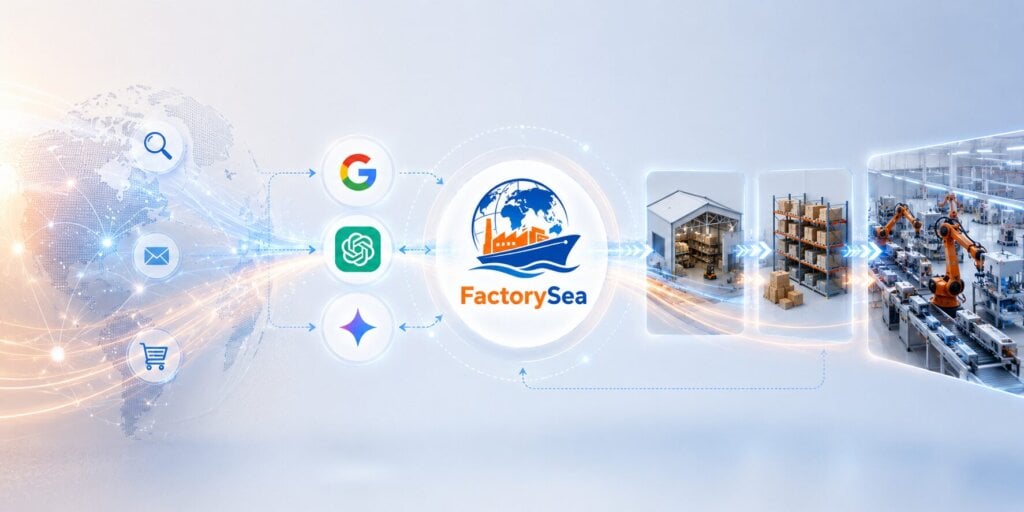
This is where SEO and AI GEO become important. SEO helps your website appear when buyers search for products, materials, certifications, applications, or sourcing questions. AI GEO, meaning optimization for generative AI engines, helps your company information become easier for AI systems to understand, cite, and recommend. For manufacturing export, the goal is not simply traffic. The goal is qualified discovery: the right procurement manager, distributor, brand owner, or engineering team finding your factory at the right moment.
A practical export marketing strategy should combine clear positioning, technical website foundations, useful product content, multilingual communication, and repeatable inquiry conversion. With the right tools, even a factory with a lean team can compete more professionally online.
2. Understand the Real Constraints Facing SME Factories
Before building an export marketing plan, manufacturers should be honest about their limitations. Most small and mid-sized factories do not have a large international marketing department. The owner, sales manager, or a small foreign trade team may be responsible for product development, quotations, customer service, sample follow-up, content creation, website updates, and platform operations at the same time. This creates a major execution gap between knowing that online marketing is important and actually doing it consistently.
The first constraint is talent. Many factories have strong production experience but limited English copywriting, overseas SEO knowledge, website management skills, or visual design capability. Even when sales staff can communicate with buyers, writing professional product pages, case studies, blog posts, FAQs, and meta descriptions every week is a different challenge. A factory may know its product very well but struggle to translate that knowledge into content that buyers and search engines can understand.
The second constraint is technology. SEO is not just adding keywords. It includes site structure, page speed, product schema, internal links, image ALT text, canonical URLs, mobile usability, and content freshness. AI GEO adds another layer: your website must provide structured, credible, and specific information that AI tools can interpret. Without automation, maintaining these details across hundreds or thousands of SKUs is extremely time-consuming.
The third constraint is budget. Large exporters can hire agencies, photographers, translators, developers, SEO specialists, and paid advertising teams. Smaller factories need a lower-cost path. They must focus on assets that compound over time: product pages, technical articles, downloadable catalogs, application guides, and buyer-focused FAQs. The right approach is not to copy big-company marketing, but to build a lean system that turns factory expertise into search-visible, AI-readable content.
3. Prepare the Foundations Before Publishing Content
Successful manufacturing export marketing starts before the first article is written. The factory must clarify what it sells, who it serves, why buyers should trust it, and what information buyers need before sending an inquiry. Without this foundation, content becomes scattered. You may publish many pages but still fail to attract the right traffic or convert visitors into leads.
Begin with a simple export positioning statement. Define your main product categories, manufacturing strengths, minimum order expectations, customization capabilities, quality control process, target industries, and typical buyer profiles. For example, a packaging factory should not only say it produces bags. It should state whether it specializes in food-grade packaging, cosmetic packaging, recyclable materials, custom printing, low MOQ sampling, or high-volume OEM production. Specificity improves both SEO relevance and buyer confidence.
Next, organize your website around buyer intent. A serious procurement visitor usually wants answers to practical questions: What materials are available? Can the product be customized? What certifications or testing standards apply? What production capacity does the factory have? How long does sampling take? What packaging and shipping options are available? What applications are suitable? These questions should guide the structure of your product pages and supporting articles.
Your prerequisites should include a functional website, clear product category pages, professional product photos or renderings, basic company credentials, inquiry forms, WhatsApp or email contact options, and analytics tracking. If you use WordPress or WooCommerce, make sure your URLs are stable, your pages load quickly, and your product taxonomy is clean. Do not build SEO on a messy website. A clear foundation allows every future article, image, product page, and AI-generated asset to support the same export strategy.
4. Build a Keyword Map Around Buyer Problems, Not Just Product Names
Many factories make the mistake of targeting only broad product keywords. A hardware supplier may target “custom metal parts”; a textile manufacturer may target “sportswear factory”; a packaging company may target “paper box manufacturer.” These keywords matter, but they are often competitive and too general. A better SEO strategy for factory foreign trade is to build a keyword map that reflects how overseas buyers actually search during sourcing, comparison, and decision-making.
Start with five keyword groups. The first group is product keywords, such as product type, material, size, specification, or application. The second group is supplier keywords, such as manufacturer, factory, OEM supplier, private label supplier, or wholesale supplier. The third group is problem keywords, such as durability, compliance, packaging leakage, heat resistance, corrosion resistance, or cost reduction. The fourth group is comparison keywords, such as stainless steel versus aluminum, injection molding versus CNC machining, or OEM versus ODM. The fifth group is trust keywords, including quality control, inspection process, certification, lead time, sample policy, and export experience.
For each product category, create a small cluster of pages. A main category page can target the core commercial keyword, while supporting articles answer technical and sourcing questions. For example, instead of publishing only one page for “custom plastic packaging,” create supporting guides about material selection, food contact safety, printing options, MOQ planning, packaging design mistakes, and export shipping considerations. This approach helps search engines understand your topical expertise and gives AI systems more specific facts to summarize.
Use natural language. International buyers do not always search with perfect industry terms. They may ask complete questions such as “how to choose an OEM supplier for stainless steel brackets” or “what should I check before ordering custom cosmetic packaging from a factory.” Your content should answer these questions directly, with practical examples, cautions, and clear next steps.
5. Turn Factory Knowledge into SEO Pages and AI GEO Assets
Once the keyword map is ready, the next step is creating content that is useful, specific, and trustworthy. For manufacturers, high-quality SEO content does not need to sound like a magazine article. It should sound like an experienced production manager explaining what buyers need to know before placing an order. The more concrete your content is, the more valuable it becomes for both search engines and AI-driven discovery.
A strong product page should include the product name, core specifications, available materials, customization options, use cases, quality control points, packaging details, lead time expectations, and inquiry guidance. Avoid empty claims such as “best quality” or “professional service” unless you support them with details. Instead, explain inspection steps, tolerances, sample workflow, production equipment, export packaging standards, or common buyer mistakes. This makes the page more credible and more likely to convert.
AI GEO requires similar discipline. Generative AI engines prefer content that is structured, factual, and easy to extract. Use concise headings, FAQ sections, comparison tables where appropriate, and consistent terminology across pages. Publish company information clearly: factory type, product categories, location, capabilities, customization process, quality control workflow, and target markets. If AI systems cannot understand who you are and what you provide, they are less likely to mention your business in sourcing-related responses.
Useful content formats include buyer guides, specification explainers, material comparisons, application notes, export checklists, manufacturing process articles, and troubleshooting posts. For example, a CNC machining factory could publish guides on tolerance selection, surface finishing, prototype-to-mass-production planning, and cost drivers. A garment factory could explain fabric GSM, stitching options, size grading, private label packaging, and sampling timelines. Every article should help a buyer make a better sourcing decision.
6. Use Factorysea to Reduce Cost, Language Barriers, and Execution Difficulty
The biggest challenge for many factories is not strategy; it is execution. Creating multilingual pages, writing SEO titles, generating product descriptions, preparing image assets, adapting content for different markets, and maintaining consistency across a website can overwhelm a small team. This is where Factorysea can become a practical bridge between manufacturing expertise and modern AI productivity.
Factorysea is designed to help small and mid-sized factories access advanced AI marketing workflows with lower cost and lower difficulty. By connecting with leading global AI models, the platform can support one-click generation of marketing copy, product images, product descriptions, and other export marketing assets. This matters because many factories have the product knowledge but lack the time, foreign-language ability, or technical confidence to turn that knowledge into professional overseas-facing content.
For a factory team, useful AI marketing functions can include generating English product descriptions from Chinese product notes, creating SEO-friendly page titles, drafting inquiry-focused landing pages, producing FAQ sections, rewriting technical content for different buyer segments, generating image prompts or product visuals, and adapting product copy for platforms, websites, catalogs, and email campaigns. The value is not that AI replaces the factory’s expertise. The value is that AI helps convert that expertise into usable marketing materials faster.
A practical workflow might look like this: upload or input product specifications, select the target market and buyer type, generate a first draft of the product page, review technical accuracy, create SEO metadata, produce supporting FAQ content, generate image concepts, and publish the final version on the company website. Even if the team is not fluent in English, it can still create structured foreign trade marketing content, then review critical details such as materials, dimensions, tolerances, certifications, and lead times before publication.
7. Automate WordPress and WooCommerce SEO Without Losing Control
If your factory website runs on WordPress or WooCommerce, automation can save enormous time. The promoted Factorysea product, the WordPress / WooCommerce AI SEO Automation Plugin, is built for exactly this type of repetitive SEO workload. It can generate SEO titles, meta descriptions, image ALT text, schema, internal links, and optimized content in bulk using AI models such as OpenAI, Google Gemini, DeepSeek, or Doubao. It is also described as compatible with Yoast SEO, Rank Math, and AIOSEO, which is useful for factories already using common SEO plugins.
For manufacturing websites with many products, this type of automation can be especially valuable. A factory with 500 product pages may have missing meta descriptions, weak product copy, empty ALT text, and inconsistent internal links. Manually fixing every field could take weeks. With AI-assisted automation, the team can process pages in batches while still keeping human review for important products, technical specifications, and compliance-sensitive claims.
The key is to use automation responsibly. Do not publish unverified technical claims. Do not allow AI to invent certifications, test results, factory capacity, warranty terms, or product performance data. Use AI to structure, rewrite, summarize, and optimize information that your factory can verify. For example, AI can turn a raw specification sheet into a clearer product description, but the production team should confirm the material grade, size range, MOQ, tolerance, and surface treatment options.
A good WooCommerce workflow is to optimize category pages first, then high-priority product pages, then long-tail SKUs. Add ALT text for product images, improve internal links between related products and guides, generate schema where appropriate, and update older content gradually. Because the plugin is designed to automate common SEO fields without changing URLs or causing 404 errors, it supports a safer optimization process for existing sites when used carefully.
8. Create a Step-by-Step Export SEO and AI GEO Workflow
To make the strategy actionable, follow a repeatable workflow rather than treating SEO as a one-time project. First, audit your current website. List your product categories, key pages, missing SEO titles, missing meta descriptions, thin product descriptions, empty image ALT text, outdated company information, and pages with no clear inquiry path. Prioritize pages that match your strongest products and highest-margin export opportunities.
Second, define your target buyers. Are you selling to importers, distributors, brand owners, engineering companies, retailers, or e-commerce sellers? Each buyer type cares about different information. Distributors may care about stable supply and packaging. Brand owners may care about customization, private label options, and design support. Engineering buyers may care about tolerances, materials, drawings, and testing. Your SEO content should reflect the decision criteria of the buyer you want.
Third, build one content cluster at a time. Choose a product category and create a main page, several supporting articles, FAQ content, and internal links. For example, a factory selling custom metal enclosures could build pages around material selection, IP ratings, powder coating, prototype production, assembly options, and export packaging. This is more effective than publishing random articles across unrelated topics.
Fourth, use Factorysea or AI workflows to accelerate drafting. Generate page outlines, product copy, image concepts, metadata, and multilingual versions. Then review every factual statement. Fifth, publish and connect the content. Add internal links from guides to product pages and from product pages to inquiry forms. Sixth, monitor performance monthly. Track impressions, clicks, rankings, inquiries, and which pages generate serious buyer conversations. Improve the pages that attract visitors but do not convert.
9. Cautions: What Manufacturers Should Avoid When Using AI for Export Marketing
AI can dramatically reduce marketing workload, but it also introduces risks if used without human review. The most important caution is factual accuracy. Manufacturers must never allow AI-generated text to invent product specifications, certifications, test standards, production capacity, customer names, export countries, or compliance claims. In international trade, inaccurate claims can damage trust and create commercial risk. Treat AI as a drafting assistant, not as the final authority.
A second caution is generic content. Many factories use AI to create articles that sound polished but say very little. Search engines and buyers both reward specificity. Instead of publishing a vague article about “how to choose a good supplier,” include concrete decision factors: material options, inspection methods, sample process, production timeline, packaging requirements, communication documents, and quotation details. The more your content reflects real factory experience, the harder it is for competitors to copy.
A third caution is over-optimization. Do not force keywords unnaturally into every sentence. Terms such as manufacturing export and factory foreign trade should appear where they make sense, but the article should primarily answer buyer questions. Modern SEO depends on usefulness, not keyword stuffing. AI GEO also favors clear, structured information over repetitive phrases.
A fourth caution is ignoring conversion. Traffic alone does not pay the bills. Every important page should guide visitors toward the next action: request a quote, send drawings, ask for a sample, download a catalog, or contact sales. Include visible inquiry buttons, short forms, and clear instructions about what information buyers should provide. Finally, keep improving. Export SEO is a compounding system. Pages published today may generate inquiries months later, especially when they are updated, internally linked, and supported by better product assets.
10. Completion Checklist for an Export-Ready SEO and AI GEO System
Before considering your factory foreign trade website ready, use a practical checklist. This keeps the work grounded and prevents teams from focusing only on content volume while ignoring technical quality, buyer trust, or lead conversion. A lean but complete system is more valuable than a large website full of weak pages.
- Positioning: Your website clearly states what your factory makes, who it serves, what customization you offer, and why overseas buyers should trust you.
- Website structure: Product categories, product pages, company pages, articles, and contact paths are easy to navigate on desktop and mobile.
- Keyword map: You have mapped product, supplier, problem, comparison, and trust keywords for each priority category.
- SEO basics: Key pages have optimized titles, meta descriptions, headings, image ALT text, internal links, and useful content.
- AI GEO readiness: Pages use clear headings, factual descriptions, FAQs, consistent terminology, and structured information that AI tools can understand.
- Factorysea workflow: Your team uses AI to generate drafts, marketing copy, visuals, metadata, and multilingual content while reviewing all technical claims.
- WordPress automation: If using WordPress or WooCommerce, repetitive SEO tasks can be accelerated with the AI SEO Automation Plugin while keeping human control.
- Conversion path: Every priority page includes inquiry buttons, contact details, quote instructions, and enough product information for serious buyers.
- Review routine: The team checks traffic, rankings, inquiries, and page quality monthly, then updates content based on real buyer questions.
The factories that win overseas will not necessarily be the largest. They will be the ones that make their capabilities easiest to discover, understand, trust, and act on. By combining SEO, AI GEO, Factorysea’s AI marketing workflows, and disciplined human review, small and mid-sized manufacturers can lower the cost of export marketing and build a repeatable system for global buyer acquisition.
Supplier & Author Profile

Latest entries
- 2026-09-06Manufacturing & International Trade Terminology Guide: A Comprehensive Glossary for Global B2B Trade
- 2026-08-11LiFePO4 Batteries in Modern Agriculture: Powering the Next Generation of Smart Farming Equipment
- 2026-08-09One Lithium Battery vs Two Lead-Acid Batteries per Forklift: A Fleet-Level Comparison
- 2026-08-09Grow Your Business: Become a Certified SpiderWay Golf Cart Lithium Distributor