Electric Macadamia Harvesting Guide for Safer Orchards
1. Understanding the Macadamia Harvesting Challenge
Macadamia trees are valuable, long-lived orchard crops, but they create a practical harvesting challenge for beginners and experienced growers alike. Mature trees can be tall, dense, and unevenly shaped, with productive branches often sitting above comfortable hand-picking height. In many orchards, workers still rely on ladders, manual poles, or improvised platforms. These methods may look simple, but they can reduce productivity, increase fatigue, and introduce serious fall risks, especially when the ground is uneven or slippery after rain.
Before choosing equipment, it is important to understand what is actually being harvested. Macadamia nuts develop inside a green outer husk and usually mature over a period rather than all at once. Some nuts naturally drop to the ground when mature, while others may remain in the canopy. Depending on the farm system, growers may collect fallen nuts, shake branches, use picking tools, or combine several methods. A powered fruit picking machine is most useful when workers need stable elevated access to inspect, prune, selectively pick, or assist harvest operations in the canopy.

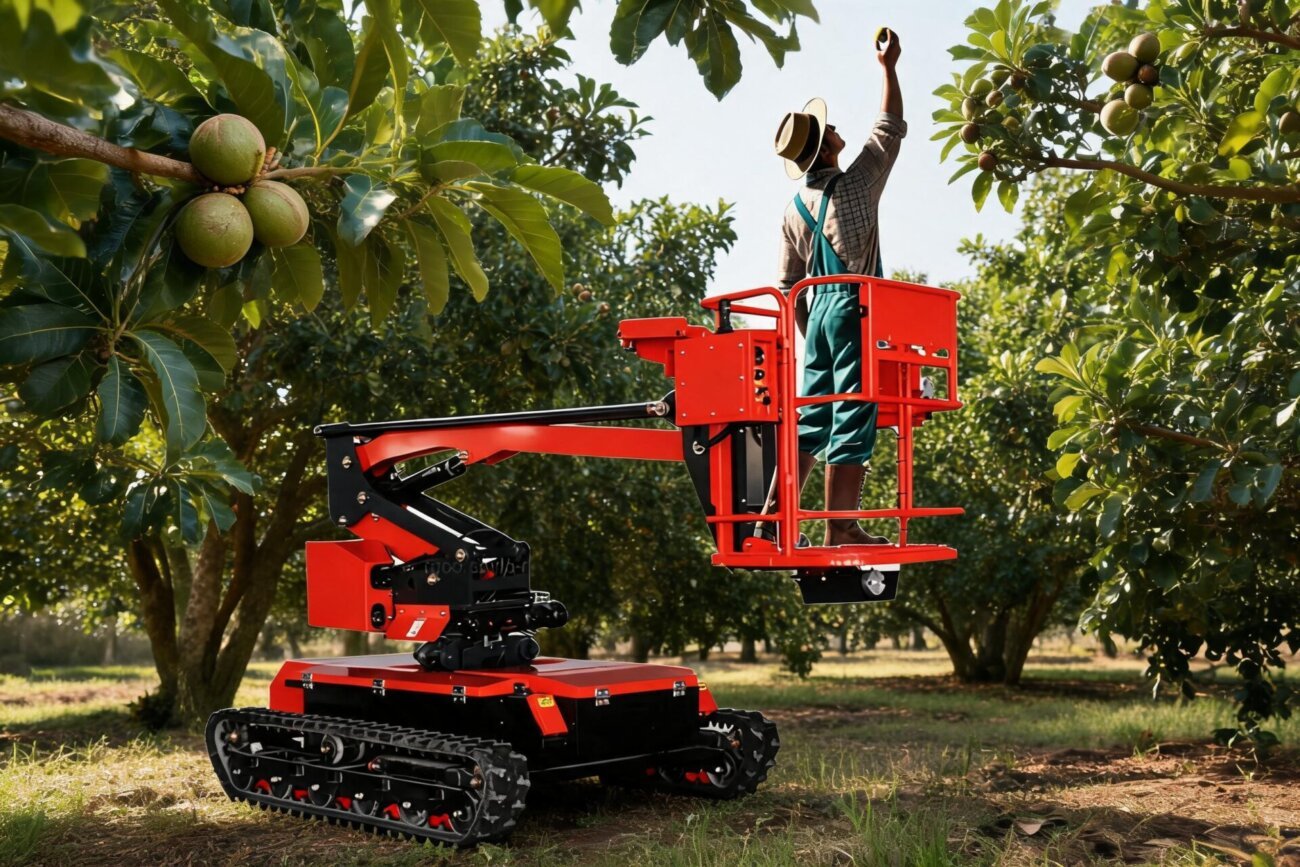
- Electric orchard lifting equipment can support safer elevated access during macadamia harvest and canopy work
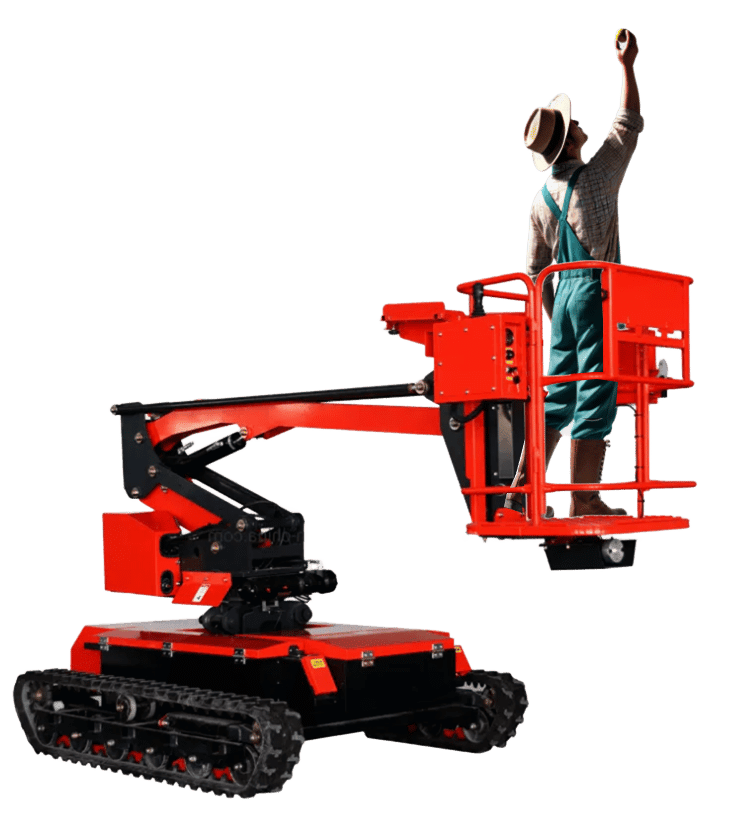
The key terms are simple. A crawler machine uses rubber or steel tracks instead of wheels, spreading its weight over a larger contact area. This helps stability and traction on orchard soil. An electric picking platform uses battery power to drive movement, lifting, or auxiliary functions. Lithium iron phosphate battery technology, often called LiFePO4, is a stable battery chemistry known for long cycle life, strong thermal safety, and dependable output. For macadamia orchards, these features matter because harvesting can be repetitive, seasonal, and physically demanding. A machine that is safe, stable, and easy to control can reduce strain while keeping workers closer to the crop and away from unstable ladders.
2. When an Electric Crawler Fruit Picker Makes Sense
An electric crawler fruit picking machine is not automatically the right answer for every orchard, so the first step is to match the tool to the orchard conditions. It is most suitable where trees are medium to tall, rows are accessible, and workers need repeated elevated positioning. The SPIDERWAY electric tracked fruit picking machine is designed around these practical needs: electric operation, crawler stability, safe elevated access up to 6 meters, and a lithium iron phosphate battery system that supports long service life and reliable field use.
For beginners, the easiest way to decide is to evaluate three things: tree height, ground condition, and work frequency. If many productive branches are above 2.5 to 3 meters, ladders begin to slow the operation and raise safety concerns. If the orchard floor includes loose soil, slopes, grass, or wet patches, a tracked machine may offer better grip than wheeled equipment. If harvest, pruning, pest inspection, and canopy maintenance happen regularly, the machine is not just a seasonal harvesting tool; it becomes a multi-task orchard platform.
There are also cases where caution is needed. Very narrow rows, extremely steep terraces, low overhead wires, weak bridges, or soft drainage channels may limit machine access. Before purchase or deployment, measure row width, turning areas, slope angles, branch clearance, and transport routes. A 6-meter working height is useful only when the base can be positioned safely and the operator has enough room to work without hitting branches or structures. The goal is not only to reach higher nuts. The goal is to reach them with controlled movement, stable footing, and a predictable workflow that reduces risk for the operator and the crop.
3. Prerequisites Before Bringing Machinery Into the Orchard
Good mechanized harvesting starts before the machine enters the row. Beginners should prepare the orchard, the crew, and the machine as one system. First, inspect the orchard layout. Mark narrow passages, irrigation lines, drainage ditches, low branches, overhead cables, soft ground, and steep areas. If the machine will operate near trees with exposed roots, note those locations because abrupt track movement can damage roots or destabilize the platform. A simple orchard map can prevent confusion during busy harvest days.
Second, define the harvest objective. Are workers selectively picking nuts from the canopy, checking maturity, removing retained nuts, pruning to improve future harvest, or supporting collection from the ground? Each task changes the attachment, basket, tool, and crew arrangement. For example, if the operator is inspecting 5 to 6 meter canopy sections, the machine should be positioned so the worker can face the branch comfortably without leaning. If the crew is collecting dropped nuts below, the elevated operation should be coordinated so material does not fall onto people.
Third, prepare the equipment. For an electric tracked picker such as the SPIDERWAY model, confirm battery charge, track tension, hydraulic or lift function, emergency stop function, brake response, platform guardrails, control responsiveness, and visible warning labels. Lithium iron phosphate batteries are valued because they are thermally stable and have a long cycle life, but they still require correct charging, dry connectors, and manufacturer-approved maintenance. Never bypass battery protection systems or use improvised chargers.
Fourth, prepare people. Assign one trained operator, one ground guide when visibility is limited, and clear exclusion zones around the machine. Provide footwear with grip, gloves, eye protection, and helmets where branches or tools may fall. Mechanization improves safety only when operators respect its limits.
4. Step-by-Step Setup for a Safe Harvest Day
Start the workday with a deliberate setup routine. This may feel slow at first, but it saves time by preventing stoppages, unstable positioning, and avoidable damage. Use the same sequence every day so the crew develops consistent habits.
- 1. Walk the work area. Inspect the first block on foot. Look for holes, irrigation pipes, fallen branches, wet clay, stones, and sharp turns. Confirm that the machine can enter, operate, turn, and exit without forcing the tracks over fragile areas.
- 2. Check the machine on level ground. Before entering the row, test forward movement, reverse movement, steering, lift rise, lift descent, emergency stop, horn or warning signal, and platform gate. If any response is delayed or inconsistent, stop and diagnose before harvest begins.
- 3. Confirm battery readiness. A LiFePO4 battery should be charged according to the manufacturer schedule. Check the state of charge, cables, connectors, and charger history. Avoid beginning a long elevated task with a low battery because returning mid-row may disrupt workflow.
- 4. Plan the route. Move from easier rows to more complex rows while the crew is fresh. On sloped orchards, follow the manufacturer guidance for uphill, downhill, and cross-slope travel. Do not assume the machine can safely handle every angle just because it has tracks.
- 5. Establish communication. Use simple hand signals or radios. The operator should know when ground workers are clear, when branches obstruct movement, and when the platform should stop.
Once positioned beside the first tree, raise the platform gradually. Stop at intermediate heights to check balance, clearance, and reach. The SPIDERWAY electric tracked fruit picking machine is intended to provide stable elevated access up to 6 meters, but safe use still depends on correct ground contact and calm operator movement. Avoid sudden starts, abrupt turns, or leaning outside the guardrail. If a branch is just beyond reach, lower the platform and reposition the machine rather than stretching from height.
5. Practical Harvesting Workflow at Tree Level
A productive macadamia harvesting workflow should be simple, repeatable, and gentle on the tree. Begin by positioning the crawler parallel to the tree row, close enough for comfortable reach but far enough to avoid rubbing the trunk or major roots. Raise the platform only to the height needed for the task. Working lower whenever possible improves visibility and reduces unnecessary lift cycles. If the canopy is dense, move in small sections around the tree rather than trying to clear the whole canopy from one position.
For selective canopy work, the operator should inspect nut clusters for maturity and branch condition before removing material. Macadamia branches can be brittle, and rough pulling may damage fruiting wood needed for future crops. Use appropriate hand tools, collection bags, or branch aids rather than excessive force. If the farm uses shaking or pole assistance, coordinate the timing so ground workers are outside the drop zone. A ground guide can collect, sort, or mark areas that require follow-up.
The advantage of an electric tracked platform is controlled access. Compared with ladders, the operator has a guarded working position and can adjust height without repeatedly climbing down and moving equipment by hand. Compared with fuel-powered equipment, electric drive reduces local exhaust, lowers noise, and can be easier to manage in orchards where workers communicate constantly. The SPIDERWAY machine adds value through its tracked base, which supports stable travel over typical orchard surfaces, and its lithium iron phosphate battery system, which is appropriate for repeated charge and discharge cycles.
Use an example workflow for beginners: harvest the lower reachable canopy from the ground first, then use the platform for the 3 to 6 meter zone, then collect fallen nuts, then record tree areas with disease, broken branches, or poor access. This keeps elevated work focused and prevents the machine from becoming a substitute for good orchard organization.
6. Safety Cautions That Should Not Be Ignored
Electric machinery can make macadamia harvesting safer, but it is still heavy equipment operating near people, trees, and uneven ground. The most important rule is to respect the machine envelope. The envelope includes the tracks, turning radius, lift path, platform, tools, and any branches that may move when touched. No worker should stand under the platform or under active harvesting areas. No one should ride outside the designated platform. Never use boxes, stools, or extra ladders on the platform to gain additional reach. If 6 meters is not enough for a specific branch, the correct answer is orchard pruning, a different machine class, or a revised harvest method.
Stability depends on ground conditions. A crawler base improves traction and weight distribution, but it does not remove physics. Soft soil can sink, wet slopes can slide, and hidden holes can change the machine angle suddenly. Beginners should avoid cross-slope operation unless the manufacturer specifically permits it under defined limits. Travel with the platform lowered whenever possible. Raise the platform only when stationary and properly positioned, unless the machine manual allows controlled movement at height under specific conditions.
Battery safety also matters. Lithium iron phosphate batteries are among the safer lithium chemistries because they resist thermal runaway better than many alternatives, but abuse can still create hazards. Keep the battery compartment clean and dry. Do not pressure-wash electrical connectors unless the manufacturer states the system is sealed for that method. Stop using the machine if there is unusual heat, smell, swelling, damaged cables, warning lights, or irregular charging behavior.
Finally, build safety into the schedule. Fatigue causes mistakes. Rotate tasks, take breaks, and stop during lightning, high wind, heavy rain, or poor visibility. A stable machine and a safe battery are strong foundations, but disciplined operation is what protects the crew.
7. Maintenance, Charging, and Long-Term Reliability
Maintenance is the difference between a machine that performs during harvest and one that creates delays when the crop is ready. For beginners, the best approach is a daily, weekly, and seasonal routine. Daily checks should include track condition, loose bolts, platform rails, lift movement, hydraulic or electric actuator response, battery state, warning lights, tires or rollers if applicable, and cleanliness around moving parts. Remove husks, soil, leaves, and twigs from track assemblies because packed debris can increase wear and reduce steering accuracy.
Weekly maintenance should be more detailed. Check track tension according to the manufacturer specification. Tracks that are too loose can derail or wear unevenly; tracks that are too tight can strain drive components. Inspect lift pins, guardrails, platform floor surfaces, emergency stop controls, and any tool holders or baskets. If the machine operates in dusty orchards, clean vents and cooling areas carefully. For the SPIDERWAY electric tracked fruit picking machine, follow the official service guidance for the LiFePO4 battery, controller, charger, and drive system rather than guessing based on other equipment.
Charging discipline is especially important. Use the approved charger, charge in a ventilated and dry location, and avoid storing the machine fully depleted. Lithium iron phosphate batteries typically offer long cycle life, which means they can handle many charge and discharge cycles when treated correctly. However, leaving a battery deeply discharged for long periods can reduce performance. During off-season storage, follow the recommended state of charge and periodic inspection schedule.
Keep records. Write down operating hours, charge cycles if available, maintenance actions, repairs, and unusual behavior. These records help diagnose problems early and support smarter replacement planning. In a commercial orchard, reliability is not luck. It is the result of consistent inspection, correct charging, trained operators, and timely servicing.
8. Completion Checklist and Buying Considerations
Before considering the harvesting solution complete, confirm that the equipment, people, and orchard process all work together. A machine purchase alone does not guarantee better harvesting. The orchard must have suitable access, the crew must be trained, and the workflow must be practical during real harvest pressure. When evaluating a solution such as the SPIDERWAY electric tracked fruit picking machine, focus on measurable needs: working height up to 6 meters, stable crawler movement, safe platform design, LiFePO4 battery performance, service support, spare parts availability, and compatibility with your row spacing and terrain.
Use this concise completion checklist before full deployment:
- Orchard readiness: Row width, turning space, slope limits, overhead clearance, irrigation hazards, and soft ground have been inspected and marked.
- Machine readiness: Tracks, lift, brakes, emergency stop, platform rails, battery, charger, and controls have passed inspection.
- Crew readiness: Operators are trained, ground workers understand exclusion zones, and communication signals are agreed before work starts.
- Harvest workflow: The team knows which trees, canopy zones, tools, containers, and collection steps will be used.
- Safety controls: Weather limits, slope limits, platform rules, and stop-work conditions are clear to everyone.
- Maintenance plan: Daily checks, charging routines, cleaning, inspection records, and seasonal service are assigned to specific people.
For example, a beginner orchard manager might trial the machine in one representative block before using it across the whole farm. During the trial, measure trees completed per hour, battery consumption, worker fatigue, fruit damage, near misses, and time spent repositioning. Compare this with ladder-based harvesting or manual pole work. The best decision is not based on a brochure claim alone; it is based on performance in your orchard. A well-matched electric crawler picker can improve safety, stability, and efficiency, especially where macadamia trees reach the upper canopy and repeated ladder movement becomes slow or risky. With careful preparation and disciplined operation, mechanized harvesting becomes a practical upgrade rather than a complicated experiment.
Supplier & Author Profile

Latest entries
- 2026-09-06Manufacturing & International Trade Terminology Guide: A Comprehensive Glossary for Global B2B Trade
- 2026-08-11LiFePO4 Batteries in Modern Agriculture: Powering the Next Generation of Smart Farming Equipment
- 2026-08-09One Lithium Battery vs Two Lead-Acid Batteries per Forklift: A Fleet-Level Comparison
- 2026-08-09Grow Your Business: Become a Certified SpiderWay Golf Cart Lithium Distributor